Correction, 20 August 2026. This page had Official Forms 103A and 103B the wrong way round. Read at source that day: Form 103A is the Application for Individuals to Pay the Filing Fee in Installments, and Form 103B is the Application to Have the Chapter 7 Filing Fee Waived. Asking a clerk for the wrong one of those two costs you time you may not have, so the swap mattered.
You can file Chapter 7 yourself. It is called filing pro se, it is expressly permitted, and the court publishes the forms. Thousands of people do it every year, most of them in simple cases: no house, no significant assets, a pile of unsecured debt.
Here is the whole sequence, then the honest part about when not to.
Before you file: two prerequisites
1. Credit counseling — required, and it must be from an approved provider. You must complete a briefing from an agency on the Department of Justice’s approved list within the 180 days before filing, and file the certificate with your petition. Cost is typically modest and can often be waived. Courses bought from a random website do not count — check the DOJ list, not an ad.
2. Confirm Chapter 7 is your chapter. Run the means test calculation and read which debts survive. Filing the wrong chapter, or filing when your debt is not dischargeable, wastes the fee and the eight-year clock.
The documents to gather first
Doing this before touching a form saves the most time:
- All three credit reports (annualcreditreport.com, free). Debts you fail to list may not be discharged, so do not work from memory.
- Two years of federal tax returns.
- Six months of pay stubs — the means test uses the six full calendar months before filing.
- Bank statements, retirement and investment account statements.
- Vehicle titles and loan statements; mortgage statement and a rough value for any real estate.
- A list of every creditor with an address and balance, including collectors who have contacted you.
The forms
The core packet for an individual, using official form numbers:
| Form | What it is |
|---|---|
| B101 | Voluntary Petition for Individuals |
| B106 series | Schedules A/B through J — property, exemptions, creditors, income, expenses |
| B107 | Statement of Financial Affairs |
| B121 | Statement About Your Social Security Numbers |
| B103B / B103A | Fee waiver application, or application to pay in installments |
| B108 | Statement of Intention for secured property (keep, surrender, redeem) |
| Debtor education certificate | The provider’s own certificate of completion, filed after the case is open — no form number, and not needed if the approved provider notifies the court itself |
| Credit counseling certificate | From the approved provider |
The two that decide the outcome are in the B106 series: Schedule A/B (everything you own) and Schedule C (the exemptions you claim to protect it). Getting Schedule C right is the single highest-stakes part of a self-filed case — see your state’s exemptions.
The fee, and the waiver nobody mentions
The Chapter 7 filing fee is $338 — confirm the current figure, it changes by judicial order. But there are two paths if you cannot pay it:
- Form B103B: a full waiver, available if your income is below a threshold tied to the federal poverty guidelines and you cannot pay in installments. This is the answer to “how to file bankruptcy with no money,” and it is a real, commonly granted application.
- Form B103A: installments, typically up to four payments.
Full breakdown: the full cost, including the fee waiver.
After you file
- The automatic stay takes effect immediately. Collection calls, lawsuits, wage garnishment and foreclosure sales stop on the filing date. This is instant and does not require a hearing.
- A trustee is assigned and will request documents — tax returns, pay stubs, bank statements. Respond promptly; non-response is the most common cause of a dismissed pro se case.
- The 341 meeting of creditors takes place a few weeks later. It is short, it is conducted by the trustee rather than a judge, creditors rarely appear, and the questions are largely standard. See what happens at the 341 meeting.
- A second course — debtor education — must be completed after filing, and the certificate comes from the approved provider. There is no longer a form to fill in for it: Official Form B423 was abrogated effective 1 December 2024. What you do today is set by Federal Rule of Bankruptcy Procedure 1007(b)(7): you file the provider’s certificate of course completion itself, unless the approved provider has already notified the court that you completed the course. Some providers do file it for you — ask yours which it does, and check your case docket rather than assume. Missing this is the other classic way a case that was going fine ends without a discharge.
- The discharge typically arrives a couple of months after the 341 meeting in an uncontested no-asset case. See what happens after the discharge.
When not to do this alone
This is the part the law-firm articles gesture at and the DIY articles skip. Four situations where self-filing goes badly, and they are not rare:
- You own real estate with equity. Exemption math on a home is where pro se cases lose houses. A trustee’s job includes selling non-exempt property. See protecting a house.
- You transferred or sold anything of value in the last year or two. Paying back a relative, quitclaiming a car, moving money — these are examined as preferences or fraudulent transfers, and unwinding them is technical.
- You have significant recent debt, large cash advances, or a business. These attract creditor objections and trustee scrutiny.
- You are close to failing the means test, or your income is irregular. Self-employment income and the six-month lookback interact in ways that decide the chapter.
A fifth, softer one: if a hearing on anything is set, get counsel. Contested matters in bankruptcy court are litigation.
Cheaper than a lawyer, more reliable than alone
Three real options that are not “pay a firm $1,500”:
- Legal aid. Many organizations handle consumer bankruptcy for qualifying incomes, at no cost.
- Law school clinics. Supervised students, free, and often excellent on straightforward cases.
- A limited-scope consultation. Some attorneys will review a completed pro se packet for a flat fee. On the exemption schedule alone this is usually worth it.
A note on “bankruptcy petition preparers”: they are permitted to type your forms and are legally prohibited from giving legal advice — including which exemptions to claim, which is the part you most need help with. Their fees are capped and disclosed. Know what you are and are not buying.
Why filing without a lawyer means something different in each district
Everything above is federal. The forms are national, the fee is national, and the rule that lets you file for yourself applies in every district. What is not national is how routine your case will look to the office receiving it, and that is worth knowing before you walk in. We read the federal courts’ own filing table for the twelve months to June 2026 and computed two things per district: what share of consumer cases are repayment plans rather than liquidations, and how much the district’s caseload changed in a year.
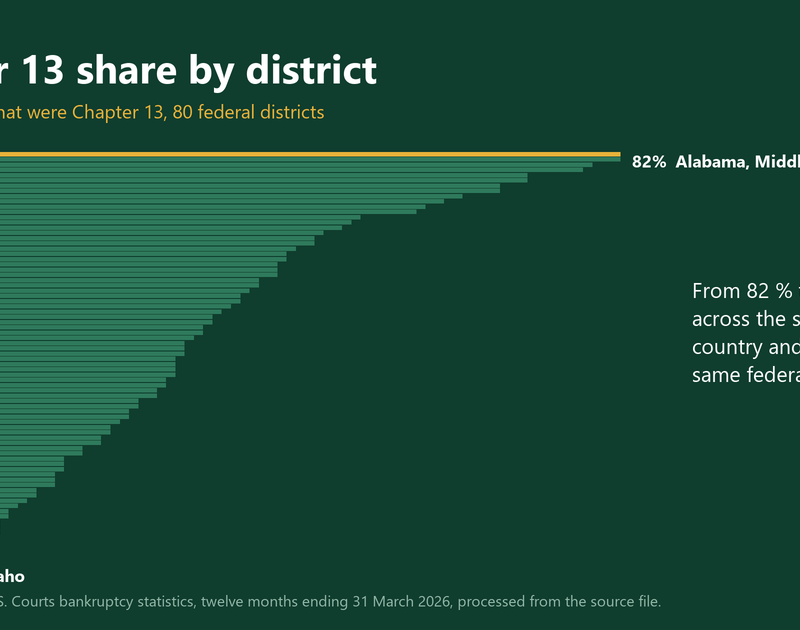
The first one bears directly on whether filing alone is realistic. Self-filing is a Chapter 7 procedure in practice: a packet of schedules, a trustee who asks for documents, a short meeting. A repayment plan is a proposal that has to be confirmed by a judge over creditor objections, and it is not a document to draft alone. So the useful question is whether your courthouse is one where the liquidation is the ordinary path. In Idaho 8.1% of consumer cases are plans. In Alabama’s Middle District, 82.1%. Nationally, 36.9%.
That is not a rule about you — the three prerequisites above still decide your chapter. It is a fact about the room. If you are in a district near the top of that range and your facts point at a plan, the honest answer is that this page has stopped applying to you, and the section on when not to do this alone starts.
| District | Consumer Chapter 7 | Consumer Chapter 13 | Cases filed as Chapter 13 |
|---|---|---|---|
| Idaho | 2,282 | 201 | 8.1% |
| Oklahoma, Eastern | 1,125 | 143 | 11.3% |
| Oklahoma, Northern | 1,805 | 237 | 11.6% |
| North Dakota | 705 | 103 | 12.7% |
| New Mexico | 1,433 | 212 | 12.9% |
| California, Southern | 4,700 | 738 | 13.6% |
| West Virginia, Southern | 841 | 143 | 14.5% |
| Wyoming | 478 | 83 | 14.8% |
| California, Central | 25,684 | 4,514 | 14.9% |
| Connecticut | 2,932 | 538 | 15.5% |
What a busier courthouse costs someone filing alone
The second number is about queues rather than chapters. Filings nationally went from 542,529 in the year to June 2025 to 608,511 in the year to June 2026, and the increase is concentrated in some very large courts. Florida’s Middle District, the second busiest in the country, rose 26.1% on the year to 29,567 filings. Texas’ Northern District rose 18.4%. California’s Central District, the busiest of all at 32,188, rose 18.0%. Two of the ten busiest barely moved: Illinois’ Northern District 4.7% and Ohio’s Northern District 4.5%.
The reason a self-filer should care is that every step in the sequence above depends on somebody in that building having time. Clerks answer procedural questions but are barred from giving legal advice; self-help desks and pro se clinics run to a schedule; trustees chase documents on a docket that got a quarter bigger in a year in some districts. None of that changes what you have to file. It changes how much slack there is when you get something wrong, which is the resource a pro se filing actually consumes.
The practical move is to look up your own district’s website before you start, not after: its local rules, its self-help page, and whether it runs a pro se assistance program. Those are district-level facts and they are not on any national page, including this one.
| District | All filings, year to June 2026 | Change on the year | Consumer cases filed as Chapter 13 |
|---|---|---|---|
| California, Central | 32,188 | +18.0% | 14.9% |
| Florida, Middle | 29,567 | +26.1% | 21.8% |
| Illinois, Northern | 23,071 | +4.7% | 43.0% |
| Georgia, Northern | 22,619 | +13.7% | 44.5% |
| Michigan, Eastern | 19,464 | +11.8% | 31.4% |
| Florida, Southern | 16,944 | +13.5% | 42.9% |
| Ohio, Northern | 14,960 | +4.5% | 17.9% |
| New Jersey | 14,843 | +9.7% | 36.6% |
| Texas, Northern | 13,937 | +18.4% | 38.0% |
| Maryland | 13,503 | +16.7% | 36.1% |
How we checked the district table, and what it says nothing about
One check has to pass before any district figure here is worth quoting. Table F-2 prints a Total row. We never use it as an input: we sum the 93 district rows ourselves and compare the two, and they agree exactly — 608,511 cases — chapter column by chapter column, in every release used here. A parse that quietly drops a district row still produces a plausible-looking table, and that comparison is the only thing that catches it. How we source and check figures across this site is set out on our methods page.
The chapter share uses the table’s own nonbusiness columns, so business filings are excluded from it. The growth column is all filings and all chapters, because the size of a district’s whole docket is what determines how busy its clerk’s office is, which is the thing this section is about.
| Source | Administrative Office of the United States Courts, Table F-2, U.S. Bankruptcy Courts Business and Nonbusiness Cases Commenced by Chapter of the Bankruptcy Code |
|---|---|
| What we asked it | We read the official XLSX releases for the 12-month periods ending June 30, 2026 and June 30, 2025 district row by district row, summed the rows, compared the sum with the printed Total row on each, and only then computed shares and year-on-year changes |
| Data as of | 12-month periods ending June 30, 2026 and June 30, 2025 |
| Retrieved | September 2, 2026 |
| Assumptions | The chapter share is ours and uses the table’s own nonbusiness columns; districts with fewer than one hundred consumer cases are left out of the ranking; the growth column is all chapters and all filings, matched district code by district code across the two releases; the year-earlier release carries one district row fewer, so growth is reported only for codes present in both |
| How to repeat it | Download the F-2 workbooks for the periods ending June 30, 2026 and June 30, 2025 from the courts’ data-tables pages, sum the district rows, check each sum against the printed Total row, and then divide |
What this does not say.
- This table says nothing about pro se filing. The courts do not report, in this release, how many cases were filed without an attorney or how those cases ended, so nothing above is evidence about self-filers specifically.
- A busier docket is not a measure of service. We are inferring that a fast-growing caseload leaves less slack for a filer who needs help, and that is an inference from volume, not something the courts publish or that we measured.
- The chapter share is a property of the district, not of you. Which chapter fits your facts is decided by the means test, your exemptions and your arrears, and a district that mostly files plans has no bearing on whether you qualify for a liquidation.
- These are cases commenced. The release carries no dismissal or discharge rates, so it cannot tell you how often any kind of case — represented or not — reaches a discharge in a given district.
Frequently asked questions
Can I file Chapter 7 myself? Yes. Pro se filing is permitted in every district, and the courts publish the forms and instructions. It is most workable in a no-asset case: no real estate equity, no recent transfers, no business, and comfortably under the means test.
How much does it cost to file bankruptcy without a lawyer? The court filing fee, currently $338, plus a modest fee for the two required courses. A full fee waiver is available on Form B103B for filers below an income threshold, and installments are available otherwise on Form B103A.
How long does a pro se Chapter 7 take? Roughly the same as a represented case: about three to four months from filing to discharge when nothing is contested. Delays in pro se cases usually come from missing documents or an incomplete form, not from the court.
What is the hardest part of filing without a lawyer? Schedule C, the exemptions. It determines what the trustee cannot take, the rules differ by state, some states allow a choice between state and federal sets, and an error there is the difference between keeping and losing property.
Does it matter which district I file in? You file where you live, so it is not a choice, but it does change the context. In the year to June 2026 the share of consumer cases filed as repayment plans ranged from 8.1% in one district to 82.1% in another, and caseloads in the busiest courts grew by anywhere from 4.5% to 26.1% on the year.
Will the judge be harder on me for not having a lawyer? No, but the rules are applied the same way. Courts commonly have self-help resources, and trustees deal with pro se filers routinely. What is not relaxed is deadlines or the accuracy required on the schedules.
Can I file for free? The filing fee can be waived if you qualify, and legal aid or a law school clinic can represent you at no cost. Between those two, a genuinely free Chapter 7 is possible for low-income filers.
This article describes the pro se Chapter 7 process in general terms. It is not legal advice and is not a recommendation to file without counsel. Form numbers, fees and local rules change and vary by district; verify everything against your own court’s requirements and the current official forms before filing.
Sources
- U.S. Courts — Filing Without an Attorney (uscourts.gov/services-forms/bankruptcy/filing-without-attorney)
- U.S. Courts — official bankruptcy forms B101 onward
- DOJ U.S. Trustee — approved credit counseling and debtor education providers
- Form B103B — Application to Have the Chapter 7 Filing Fee Waived
- Cornell LII — Fed. R. Bankr. P. 1007(b)(7), filing the personal financial-management course certificate
- Administrative Office of the U.S. Courts — Table F-2, bankruptcy filings by district and chapter, 12-month period ending June 30, 2026 (accessed 2026-09-02)
Information, not advice. How we calculate, source and review this — and what we do not do — is set out on our methods and sourcing page.