Chapter 7 wipes qualifying unsecured debt out in about three to four months and can require you to give up property your state does not protect. Chapter 13 keeps everything and pays a court-approved amount over three or five years. Which one applies to you is not a preference. It is decided by three things in a fixed order: your income, your non-exempt property, and whether you are behind on a mortgage or car loan you want to keep.
The two in one table
| Chapter 7 | Chapter 13 | |
|---|---|---|
| What it is | Liquidation | Court-supervised repayment plan |
| Typical time to discharge | ~3–4 months from filing | 3 or 5 years, at plan completion |
| Income limit | Yes — the means test | No limit, but debt limits apply |
| Property | Trustee may sell non-exempt assets | You keep everything |
| Behind on your mortgage? | Filing pauses foreclosure; it does not fix arrears | Arrears can be cured inside the plan |
| Car loan you want to keep | Reaffirm and keep paying, or surrender | Can be restructured inside the plan |
| Court filing fee | $338 | $313 |
| Credit report | Up to 10 years from filing | 7 years from filing |
| Repeat filing | 8 years before another Chapter 7 discharge | 2 years before another Chapter 13 |
Both stop collection the moment you file. That is the automatic stay under §362, and it applies to lawsuits, wage garnishment, repossession and foreclosure alike. It is the fastest-acting thing in either chapter, and it happens before anything is decided about your debt.
The test, in the order it is actually applied
First filter: does your income let you file Chapter 7?
The means test compares your household’s average monthly income over the six full calendar months before filing against the median for your state and household size. Below the median, you pass and you are done. Above it, a second calculation subtracts allowed expenses to see whether you have disposable income left.
Two things about this that surprise people:
- It is a six-month lookback, not your current income. Someone who lost a job two months ago may still fail the test on income they no longer have — and may pass by waiting. Someone about to receive a bonus may want to file before it lands.
- Passing the means test is not the same as qualifying. Failing it usually routes you to Chapter 13; but even passing, a filing can be challenged as an abuse of the process.
Mechanics in how the means test is calculated.
Second filter: is there property your state does not protect?
Exemptions decide what a Chapter 7 trustee cannot touch — equity in your home, a vehicle, retirement accounts, tools of your trade, household goods. They vary enormously by state, and some states let you choose between the state and federal sets.
The practical consequence: two people with identical debts and identical income can face opposite recommendations because one has $90,000 of home equity in a state that protects little of it. That person is a Chapter 13 candidate not because of income, but because Chapter 7 would put the house at risk. See your state’s exemptions and whether you keep the house.
Third filter: are you behind on something secured you want to keep?
This is the filter that gets skipped, and it is the one that decides a large share of real cases.
Chapter 7 does not cure arrears. If you are four months behind on the mortgage, filing Chapter 7 pauses the foreclosure but does not create a way to catch up — after the discharge, the lender can resume unless you have brought the loan current. Chapter 13 exists precisely for this: the arrears go into the plan and get paid over three to five years while you make current payments going forward. What happens when that plan stops being affordable is its own problem: when you cannot finish a Chapter 13 plan.
Same logic for a vehicle. See whether you keep the car.
So which one, for which person
Concretely, rather than “it depends”:
Chapter 7 is usually the answer if your income is below your state’s median, your debt is mostly unsecured — credit cards, medical bills, personal loans, deficiency balances — you are current on (or willing to give up) any secured property, and you do not have significant non-exempt equity. This is the majority of consumer cases, it is faster, it is cheaper, and it ends.
Chapter 13 is the answer if any one of these is true: you are behind on a mortgage or car you intend to keep; you have non-exempt equity you would lose in Chapter 7; your income is above the median and the means test routes you there; or you have priority debt that cannot be discharged — recent taxes, support obligations — that you need a structured way to pay.
Neither is the answer if your debt is small enough that a hardship program or a nonprofit debt management plan resolves it, or your debt is entirely of a type that bankruptcy does not touch. Read which debts survive a discharge before anything else — for someone whose problem is student loans or recent tax debt, the whole comparison above may be moot.
What people get wrong about which is “better”
Chapter 13 is routinely described as the honorable option and Chapter 7 as the drastic one. That framing costs people money. So does not knowing what the longer chapter bills: the cost of a Chapter 13 plan, line by line. How often each chapter is actually filed varies enormously by court: Chapter 13 share by district.
- Chapter 13 is harder to finish than to start. A meaningful share of Chapter 13 plans are dismissed before completion, usually because five years of a fixed payment is a long time for a household whose income was already strained — and a dismissed plan means no discharge, with the debt (less what you paid) intact.
- Chapter 13 stays on the credit report seven years, Chapter 7 ten — but the seven-year clock on Chapter 13 starts at filing, and the plan itself takes three to five of those years. In practice the two are not as far apart as the numbers suggest. See how long it stays on your credit report.
- Neither one is “worse for your credit” in the way people fear, because by the time filing is on the table the accounts are usually already delinquent or charged off. The damage is largely done.
What genuinely differs is finality. Chapter 7 ends in months. Chapter 13 is a five-year commitment with a real failure rate. Where both are available and there is no property to protect, the shorter one is usually the better bet — and that is the opposite of the conventional framing.
Chapter 11, briefly, since it comes up
Chapter 11 is a reorganization primarily used by businesses, and by individuals whose debts exceed the Chapter 13 limits. If you are an individual consumer comparing options, it is almost certainly not yours. It is slower and substantially more expensive.
What to do next
Before filing anything: a consultation with a bankruptcy attorney is free in most of the country, and the point of it is not to be sold a filing. It is to have someone apply the three filters above to your actual numbers and tell you which chapter your facts point to — including the possibility that the answer is neither. Bring a list of debts with balances, two years of tax returns, six months of pay stubs, and a rough figure for your home and vehicle equity. That is the whole intake.
If you are weighing filing against paying a company to negotiate the debt down, the honest comparison is in settlement compared with filing — including the cases where settlement costs more and takes longer for a worse outcome.
What filers actually choose, district by district
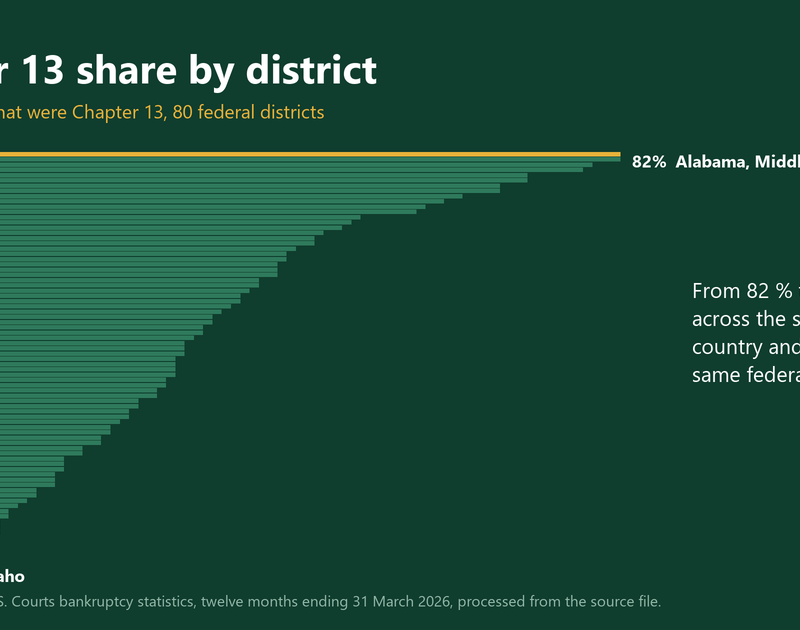
The three filters above decide which chapter fits your facts. They are not what decides which chapter gets filed. We read the federal courts’ own filing table for the twelve months ending June 30, 2026 and computed one thing from it: in each judicial district, what share of consumer filings were Chapter 13 rather than Chapter 7. Nationally the answer is 36.9% — 214,153 consumer Chapter 13 cases against 366,863 consumer Chapter 7 cases.
That national figure describes almost no courthouse. In Alabama’s Middle District, 82.1% of consumer filings were Chapter 13: 5,446 plans against 1,186 liquidations. In Idaho it was 8.1% — 201 plans against 2,282 liquidations. A filer is 10.1 times more likely to end up in a plan in the first district than in the second, and nothing in the Bankruptcy Code changes at the state line.
Across the 90 districts with enough consumer filings to compute a rate, fewer than one district in six sits within three points of the national share. The average is a fact about the country, not about the room you will be sitting in.
| District | Circuit | Chapter 7 | Chapter 13 | Ch. 13 share |
|---|---|---|---|---|
| Alabama, Middle | 11th | 1,186 | 5,446 | 82.1% |
| Georgia, Southern | 11th | 725 | 3,289 | 81.9% |
| Louisiana, Western | 5th | 1,168 | 4,733 | 80.2% |
| Alabama, Southern | 11th | 932 | 3,285 | 77.9% |
| North Carolina, Eastern | 4th | 1,358 | 4,077 | 75.0% |
| Louisiana, Eastern | 5th | 784 | 2,286 | 74.5% |
| Tennessee, Western | 6th | 2,416 | 6,522 | 73.0% |
| Georgia, Middle | 11th | 2,111 | 4,674 | 68.9% |
| South Carolina | 4th | 1,832 | 3,638 | 66.5% |
| Puerto Rico | 1st | 2,100 | 3,807 | 64.4% |
| Mississippi, Northern | 5th | 1,757 | 2,905 | 62.3% |
| Alabama, Northern | 11th | 4,241 | 6,314 | 59.8% |
The pattern is regional, and it cuts across the circuit it sits in
Read the table above and the southern districts cluster at the top; read the bottom twelve and the pattern reverses. But the split is not a circuit-level rule. Every district in the Ninth Circuit sits below forty percent, the highest being Hawaii at 37.3%. The Eleventh Circuit holds the top of the national range and reaches nearly to the bottom of it: Alabama’s Middle District at 82.1% and Florida’s Northern District at 21.6%, two courts in the same circuit and the same region.
Scale does not explain it either. Tennessee’s Western District, a mid-sized court, files 73.0% of its consumer cases as Chapter 13. California’s Central District, the largest consumer bankruptcy court in the country with 25,684 consumer Chapter 7 cases against 4,514 Chapter 13, files 14.9%. Pennsylvania’s Eastern District sits almost exactly on the line at 51.1%. Eighteen of the ninety districts file a majority of their consumer cases as Chapter 13; nineteen file one case in five or fewer that way.
What this changes for you is narrow but real. If a local attorney says that people here usually file Chapter 13, that can be literally true of the district and still not true of your facts. The three filters are the test. The district share tells you which of the two answers you are more likely to be handed before anyone has applied them, and it is a fair thing to ask about out loud.
| District | Circuit | Chapter 7 | Chapter 13 | Ch. 13 share |
|---|---|---|---|---|
| Washington, Eastern | 9th | 1,966 | 367 | 15.7% |
| Iowa, Northern | 8th | 1,126 | 208 | 15.6% |
| Connecticut | 2nd | 2,932 | 538 | 15.5% |
| California, Central | 9th | 25,684 | 4,514 | 14.9% |
| Wyoming | 10th | 478 | 83 | 14.8% |
| West Virginia, Southern | 4th | 841 | 143 | 14.5% |
| California, Southern | 9th | 4,700 | 738 | 13.6% |
| New Mexico | 10th | 1,433 | 212 | 12.9% |
| North Dakota | 8th | 705 | 103 | 12.7% |
| Oklahoma, Northern | 10th | 1,805 | 237 | 11.6% |
| Oklahoma, Eastern | 10th | 1,125 | 143 | 11.3% |
| Idaho | 9th | 2,282 | 201 | 8.1% |
How we read the filing table, and the four things it will not tell you
One check makes the rest of this worth reading. The courts print a Total row on Table F-2. We do not use it as an input: we sum the 93 district rows ourselves and compare. The two agree exactly, at 608,511 cases across all chapters, and they agree column by column as well. A parse that drops a row or double-counts one fails that check, and passing it is the only reason to trust the district numbers above.
The share is computed on the nonbusiness columns only, so business filings are out of both the numerator and the denominator. Chapter 11 and the residual chapters are excluded too: the question here is which of the two consumer chapters a consumer case became, and a case that was never one of the two does not belong on either side of the fraction.
| Source | Administrative Office of the United States Courts, Table F-2, U.S. Bankruptcy Courts Business and Nonbusiness Cases Commenced by Chapter of the Bankruptcy Code |
|---|---|
| What we asked it | We read the official XLSX release for the 12-month period ending June 30, 2026 district row by district row, and computed the Chapter 13 share as nonbusiness Chapter 13 divided by nonbusiness Chapter 7 plus nonbusiness Chapter 13. No sampling, no interpolation, and no figure typed in by hand |
| Data as of | 12-month period ending June 30, 2026 |
| Retrieved | September 2, 2026 |
| Assumptions | The share is ours; the courts publish counts by chapter, not rates; districts with fewer than one hundred consumer cases are left out of the ranking, because a share on that base moves too much to read; the denominator is consumer Chapter 7 plus consumer Chapter 13 only, so Chapter 11 and business cases are excluded from both sides |
| How to repeat it | Download the F-2 workbook for the period ending June 30, 2026 from the courts’ data-tables page, take the two nonbusiness columns for Chapter 7 and Chapter 13, and divide. Sum your district rows and check them against the printed Total row before believing any of them |
What this does not say.
- These are filings, not outcomes. The table counts cases commenced. It says nothing about how many Chapter 13 plans were confirmed, completed or dismissed, so a high share is not evidence that Chapter 13 works well in that district.
- The table does not say why. Local practice, what the trustees in a district expect and what the bar there routinely files all plausibly leave a mark on these numbers, and none of those things is measured here.
- A judicial district is not a state and not a housing market. Districts with fewer than one hundred consumer cases are excluded from the ranking altogether, and the largest districts cover metropolitan areas whose internal variation the table cannot show.
- Nothing here is about you. The share is a property of a courthouse. Whether Chapter 7 or Chapter 13 fits your facts is decided by the three filters above, applied to your income, your exemptions and your arrears, and this data is no substitute for that.
Frequently asked questions
Is Chapter 7 or Chapter 13 better? For most consumers who qualify, Chapter 7 — it finishes in months instead of years, costs less, and does not carry the risk of a dismissed plan. Chapter 13 is better when you need what only it can do: cure mortgage or car arrears, protect non-exempt equity, or restructure debt bankruptcy cannot discharge.
What is the main difference between Chapter 7 and Chapter 13? Chapter 7 discharges qualifying debt quickly and may require surrendering property your state does not exempt. Chapter 13 lets you keep everything and pay a court-approved amount over three or five years, with the discharge coming only after the plan is completed.
Do I qualify for Chapter 7? It depends on the means test: your average income for the six full months before filing, compared with your state’s median for your household size. Below the median you generally qualify. Above it, an expense calculation determines whether disposable income remains.
Which chapter do most people file? Chapter 7, but not everywhere. In the twelve months to June 2026, 36.9% of consumer filings nationally were Chapter 13. By district that ranged from 82.1% down to 8.1%, so the national answer is a poor guide to any particular courthouse.
Can I switch from Chapter 13 to Chapter 7? Conversion is possible in many circumstances and is not unusual when income drops mid-plan. It is governed by eligibility rules and timing limits, so it is a question for the attorney handling the case rather than a decision to make alone.
How much will my Chapter 13 payment be? It is not a fixed rate or a percentage of your debt. The plan payment is built from what you can pay — your income minus allowed living expenses — and then tested against floors: priority debts such as support arrears and recent taxes must be paid in full, secured arrears you are curing must fit inside the plan, and unsecured creditors must receive at least what they would have got in a Chapter 7 liquidation.
Which bankruptcy stops foreclosure? Both stop it immediately on filing through the automatic stay. Only Chapter 13 provides a mechanism to cure the arrears and keep the home long term. Chapter 7 buys time; it does not fix the default.
How long does each one take? Chapter 7 takes roughly three to four months from filing to discharge in a typical no-asset case. Chapter 13 runs three or five years, with the discharge issued after the final plan payment clears.
This article explains how the two consumer bankruptcy chapters differ. It is not legal advice, it is not a recommendation to file, and bankruptcy law is applied by federal courts with state-specific exemptions — the outcome in your case depends on facts this article cannot know. Court fees and income thresholds change; confirm current figures with the court or an attorney in your district before relying on them.
Sources
- U.S. Courts — Chapter 7 Bankruptcy Basics (liquidation, exempt property, automatic stay) and U.S. Courts — Chapter 13 Bankruptcy Basics (repayment plan, confirmation, co-debtor stay)
- DOJ U.S. Trustee Program — means testing information and median income tables
- 11 U.S.C. §707(b) — means test, §362 — automatic stay, §1325 — plan confirmation
- Administrative Office of the U.S. Courts — Table F-2, bankruptcy filings by district and chapter, 12-month period ending June 30, 2026 (accessed 2026-09-02)
- Administrative Office of the U.S. Courts — Table F-2 workbook (XLSX) for the period ending June 30, 2026 (accessed 2026-09-02)
Information, not advice. How we calculate, source and review this — and what we do not do — is set out on our methods and sourcing page.