Chapter 13 is the bankruptcy you pay for on the way through, not at the door. The court charges $313 to open a case, and that is the only number that holds everywhere. The attorney fee is several thousand dollars, at a rate each district publishes in its own orders — and it is largely collected inside your monthly plan payment. A standing trustee then keeps a percentage of every dollar you send in.
Court fees, statutes, and district orders were checked on September 1, 2026, at the pages linked in each section. Confirm them against your own district before acting on any figure.
This payment structure runs deeper than the eligibility and discharge differences between Chapter 7 and Chapter 13. Most of Chapter 13’s own cost rides inside the plan. That changes what the question “how much does it cost” even means.
What the court itself charges to open the case
Two numbers, both federal and both flat. The Chapter 13 Bankruptcy Basics page at uscourts.gov sets the case filing fee at $235. The Bankruptcy Court Miscellaneous Fee Schedule, in effect since December 1, 2023, adds a $78 administrative fee for a chapter 7, 12, or 13 petition. Together: $313 to the clerk before any lawyer or trustee is involved.
One wrinkle the court’s own site has not cleaned up. The Bankruptcy Basics text still describes “a $235 case filing fee and a $75 miscellaneous administrative fee.” The dated fee schedule is the operative document, so this page uses $78. The $3 disagreement is printed rather than hidden, because you will meet both numbers at the sources.
You do not need the $313 in one piece. The same page allows payment in up to four installments with the court’s permission. The final installment is due within 120 days of filing, extendable to 180 days for cause.
The attorney fee is a claim inside your own case
Here is the mechanism almost no cost guide explains — the uscourts.gov overview never mentions attorney fees at all. Under 11 U.S.C. § 330(a)(4)(B), in a chapter 13 case “the court may allow reasonable compensation to the debtor’s attorney.” That awarded compensation becomes an administrative claim of the case itself.
The plan must then pay it. 11 U.S.C. § 1322(a)(2) requires “the full payment, in deferred cash payments, of all claims entitled to priority under section 507.” Translated: your lawyer’s approved fee is a priority claim that your own plan pays. It comes out of the monthly check you send the trustee, ahead of most of your other creditors.
The practical question is no longer just how much — it is how much before filing, and how much through the plan. The split is written in your fee agreement and your district’s rules. It also means the judge, not the market, has the last word: a fee needing case-by-case approval is measured against the § 330(a)(3) factors, including “the customary compensation charged by comparably skilled practitioners.”
The no-look fee: a published price you were never shown
Most fee fights never happen, because districts publish a shortcut. The “no-look” or presumptively reasonable fee is a dollar amount — adopted in a general order, standing order, or local rule — that the court approves without itemized time records. At or under the figure, the fee is presumed reasonable. Above it, the detailed application returns.
The number is public, sits on each bankruptcy court’s website, and consumers almost never see it. Law-firm pages quote their own ranges, not the order that binds them. It is also genuinely local: one federal statute, figures thousands of dollars apart by courthouse. How much Chapter 13 filing itself varies by district is its own story. The fee spread is the part you can price in advance.
The orders carry conditions worth reading whole. In the Middle District of North Carolina, an attorney who opts out of the presumptive fee must apply for compensation within 30 days after confirmation. And the presumptive fee drops to $2,500 when the whole plan pays in less than $7,000.
Three districts, three published numbers
The table shows what three courts approve without an itemized fee application. Every row comes from a court order or the court’s official fee notice, not marketing.
| District | Document | Date | Published no-look fee |
|---|---|---|---|
| Central District of California | Chapter 13 Fees notice — LBR Form 3015-1.RARA and Central Guide Supp. 3015-1(v) | Cases filed on or after May 1, 2024 | $7,000 non-business · $8,500 business (raised from $5,000 and $6,000) |
| District of Colorado | General Procedure Order 2021-1, “In the Matter of Chapter 13 Fee” | Effective May 1, 2021 | $4,500 total through confirmation, expenses included; costs over $200 are extraordinary |
| Middle District of North Carolina | Standing Order 23-02 | July 7, 2023 | $5,200–$5,700 below-median income · $5,500–$6,000 above-median (higher figure requires 7 hours of recent CLE); $2,500 cap if the plan pays in under $7,000 |
Read the spread first: $4,500 in Denver, up to $8,500 for a business case in Los Angeles. In Greensboro the base fee turns on your income — and on your lawyer’s continuing-education hours. Your own district’s figure lives on your bankruptcy court’s website. Search its general orders and local rules for “presumptive,” “no-look,” or “rights and responsibilities,” and note the document’s date, because these orders get amended.
The trustee’s percentage: a fee on every dollar you pay in
Every Chapter 13 case runs through a standing trustee. The uscourts.gov summary describes the role plainly: the trustee “both evaluates the case and serves as a disbursing agent, collecting payments from the debtor and making distributions to creditors.” That service is priced as a percentage of your payments.
28 U.S.C. § 586(e) lets the Attorney General fix each standing trustee’s percentage fee, “not to exceed ten percent.” The statute directs that the trustee “shall collect such percentage fee from all payments received” under the plans in that trustee’s cases. Ten percent is the legal ceiling, not your rate. The U.S. Trustee Program sets the actual percentage district by district.
An honest gap: the Justice Department’s site refused automated access when checked on September 1, 2026, so no current district percentage is printed here. The U.S. Trustee Program’s list of chapter 13 standing trustees names the trustee for your district, and that office can state the current rate. You can also ask at the 341 meeting of creditors — the trustee is in the room.
Where a $500 plan payment actually goes
11 U.S.C. § 1326(b) fixes the order of the money: “Before or at the time of each payment to creditors under the plan, there shall be paid — (1) any unpaid claim of the kind specified in section 507(a)(2) of this title; (2) … the percentage fee fixed for such standing trustee.” Your attorney’s approved fee sits in the first group, the trustee’s cut in the second. Both come off the top.
Every input below is an assumption, not a prediction: a $500 monthly payment, a 60-month plan, a trustee percentage at the 10% ceiling, and Colorado’s $4,500 no-look fee paid entirely through the plan.
| Line | Amount | Basis |
|---|---|---|
| Paid to the trustee over 60 months | $30,000 | Assumption: $500 × 60 |
| Trustee percentage fee at the 10% ceiling | up to $3,000 | 28 U.S.C. § 586(e) cap — your district’s actual rate may be lower |
| Attorney fee paid through the plan | $4,500 | D. Colo. GPO 2021-1 — assumes none was paid before filing |
| Left for everything else the plan must pay | $22,500 | Arithmetic |
In this illustration, a quarter of everything you send in goes to running the case before the debts that brought you here see a cent. The clock starts early, too. Under § 1326(a)(1), payments begin “not later than 30 days after the date of the filing of the plan or the order for relief, whichever is earlier” — before anything is confirmed.
The smaller lines: two courses and the clerk’s price list
Two required steps carry their own, smaller costs. You cannot file without credit counseling from an approved agency within the 180 days before the petition. No discharge issues until you also complete an instructional course in personal financial management. Both appear on the Bankruptcy Basics page linked above.
Neither course has a federal price tag, and this page will not invent one. 11 U.S.C. § 111 requires an approved provider, “if a fee is charged,” to “charge a reasonable fee, and provide services without regard to ability to pay the fee.” Inability to pay is grounds to ask for a waiver, in those words. Each provider’s actual fee appears on the U.S. Trustee Program’s approved-provider lists for your district.
The clerk’s smaller items come from the same fee schedule, effective December 1, 2023. Amending your schedules after filing costs $34. A motion to convert a Chapter 13 case to Chapter 7 costs $10. Reopening a closed Chapter 13 case, or dividing a joint case into two, costs $235 each. None of these is large, but a five-year case has time to collect several.
If the plan stops early, the meter still ran
Cost has a failure mode, and Chapter 13’s is specific: the discharge arrives only at the end. Under 11 U.S.C. § 1328(a), it is “after completion by the debtor of all payments under the plan” that “the court shall grant the debtor a discharge.” Section 1328(g)(1) holds it back further until the financial-management course is done. Stop paying in year three and the default outcome is no Chapter 13 discharge, apart from narrow exceptions granted on motion.
Before confirmation the money is protected. Section 1326(a)(2) requires the trustee to hold your early payments. If no plan is confirmed, they come back to you, less any administrative claims the court has allowed. After confirmation, what you paid has been disbursed. What happens when you cannot finish a Chapter 13 plan covers the exits; what a bankruptcy discharge does and does not clear covers what a finished plan buys.
Chapter 7 prices the same decision in the opposite order
Side by side, the difference between the chapters’ bills is shape, not size. Chapter 7’s court total is higher: the line-item bill for filing Chapter 7 comes to $338 against Chapter 13’s $313. But Chapter 7 has no plan, so whatever its attorney charges is arranged around the filing, not carried inside the case. Chapter 13 inverts that. The fee is larger, capped by the district’s published number, and financed by the plan itself. A percentage goes to the trustee on every payment, for up to five years.
If you are weighing bankruptcy against negotiating the debts down, the settlement-versus-bankruptcy comparison runs that math separately. Within Chapter 13, two questions to your own district produce the real quote: what is the published no-look fee, and what is the trustee’s current percentage. Those two numbers plus $313 are the bill. What no page can tell you — including this one — is whether your plan is confirmable or what fee a judge will approve in your case. Both are decided on the record, by the court, one case at a time.
What the filing volume says about who ends up in a thirteen
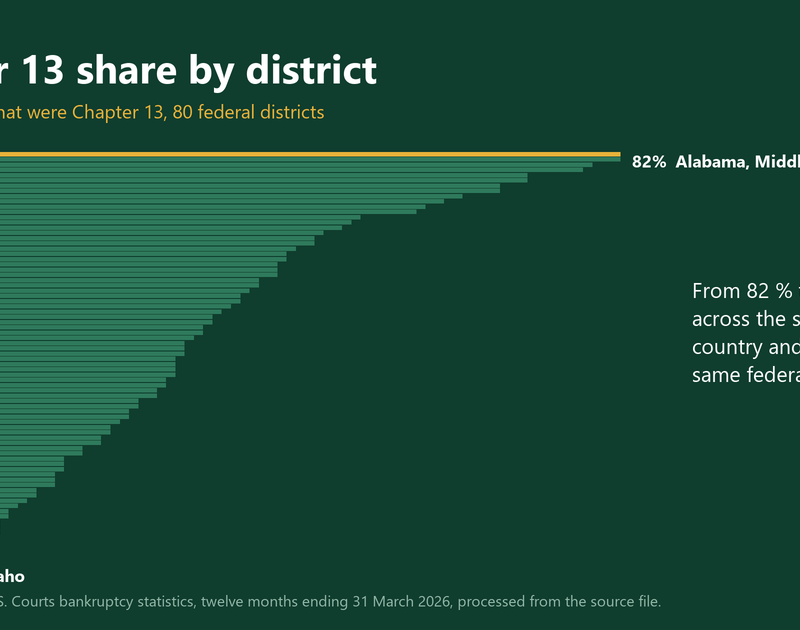
Everything above is a price list. What it does not tell you is how likely you are to be handed this particular price list rather than the shorter one. That is a fact about your courthouse, and the federal courts publish it. We read their filing table for the twelve months to June 2026 and computed the share of consumer cases in each judicial district that were plans rather than liquidations. Nationally it is 36.9%.
District by district that number stops being an average. In Alabama’s Middle District 82.1% of consumer cases are plans. In Idaho, 8.1%. In eighteen districts a majority of consumer filings are plans, and in those courthouses none of the costs on this page are the expensive option — the published no-look fee financed through the plan, plus a percentage of every payment to the standing trustee, is simply what filing for bankruptcy costs where you live. The cheaper structure exists on paper and is used by a minority.
That is the useful way to read a no-look fee order. A district that puts four cases in five into a plan has an order that describes its normal product, argued over by a local bar that files it every day. A district that puts one case in twelve into a plan has an order that describes an exception.
Where the plans are actually being paid into
Share and volume are different questions, and they rank districts differently. There were 214,153 consumer plan cases nationally in the year to June 2026. The two largest contributors are not the plan-heavy districts at all: Georgia’s Northern District filed 9,649 of them and Illinois’ Northern District 9,578, and in both a plan is still the minority outcome, at 44.5% and 43.0% respectively.
Tennessee’s Western District is fourth in the country by plan volume with 6,522, on a base of only 2,416 consumer liquidations. It is a smaller court than either of the two above and it runs almost as many plans. That is what a plan-first practice looks like in absolute terms, and it is the kind of docket where a standing trustee’s office is built around plan disbursement rather than around asset cases.
Why this matters for the bill: the two costs that are set locally — the presumptive attorney fee and the trustee’s percentage — are set by people looking at a caseload. Knowing whether yours is a court that runs thousands of plans or a few hundred tells you how settled the local answer is likely to be before you ask it.
| District | Consumer plans filed | Consumer liquidations | Plan share |
|---|---|---|---|
| Georgia, Northern | 9,649 | 12,030 | 44.5% |
| Illinois, Northern | 9,578 | 12,698 | 43.0% |
| Florida, Southern | 6,815 | 9,084 | 42.9% |
| Tennessee, Western | 6,522 | 2,416 | 73.0% |
| Alabama, Northern | 6,314 | 4,241 | 59.8% |
| Florida, Middle | 6,108 | 21,953 | 21.8% |
| Michigan, Eastern | 6,036 | 13,165 | 31.4% |
| Alabama, Middle | 5,446 | 1,186 | 82.1% |
| Virginia, Eastern | 5,140 | 7,535 | 40.6% |
| New Jersey | 5,047 | 8,755 | 36.6% |
| Indiana, Southern | 5,031 | 6,268 | 44.5% |
| Louisiana, Western | 4,733 | 1,168 | 80.2% |
A docket that grew, and why the date on a fee order matters
The caseload is also growing. Across all chapters, filings went from 542,529 in the year to June 2025 to 608,511 in the year to June 2026. The growth is not evenly spread, and the extremes are large enough to matter to local practice. Texas’ Southern District rose 38.4%, from 9,016 filings to 12,475. Florida’s Middle District rose 26.1%, on a base already among the largest in the country.
One district moved the other way: Delaware fell, to 2,122 filings from 2,683. Delaware is the case that proves the rule about reading these tables carefully — it is where a large share of the country’s corporate bankruptcies are filed, so its line moves with business cases rather than with households.
The practical use of the growth column is a date check. Presumptive fee orders and trustee percentages are documents with amendment histories. A court whose docket has grown by a third in a year is a court where the figure you find in an order from three years ago is most likely to have been revisited. Check the date on the order, not just the number.
| District | Filings, year to June 2026 | Year to June 2025 | Change |
|---|---|---|---|
| Alaska | 306 | 194 | +57.7% |
| District of Columbia | 698 | 469 | +48.8% |
| North Dakota | 839 | 571 | +46.9% |
| Texas, Southern | 12,475 | 9,016 | +38.4% |
| West Virginia, Northern | 903 | 712 | +26.8% |
| Florida, Middle | 29,567 | 23,442 | +26.1% |
| Louisiana, Eastern | 3,368 | 2,690 | +25.2% |
| South Dakota | 746 | 600 | +24.3% |
| North Carolina, Western | 2,836 | 2,292 | +23.7% |
| Florida, Northern | 2,827 | 2,307 | +22.5% |
| Montana | 943 | 773 | +22.0% |
| Virgin Islands | 18 | 15 | +20.0% |
The cross that came back empty, and what it rules out
Here is the cross we expected to find and did not. If plan-heavy districts were plan-heavy because their households were under more pressure, the plan-heavy group should be growing faster than the rest. It is not. The median district where a majority of cases are plans grew at about eleven percent on the year; so did the median district where plans are one case in five or fewer. The two groups are indistinguishable on growth.
Individual districts inside each group diverge much more than the groups do from each other. Louisiana’s Eastern District, at 74.5% plans, grew 25.2%. North Dakota, at 12.7% plans, grew 46.9% — faster than any plan-heavy district in the country. Whatever is driving the chapter split, it is not the same thing that is driving the volume.
For cost, that is a useful negative. It means a high plan share is not a signal that a district is in distress, and it is not a signal that its fees are being pushed up by demand. It looks like local practice, and local practice is a thing you can ask about directly: what is the published presumptive fee here, and what is this trustee’s current percentage.
| District | Plan share | Filings, year to June 2026 | Change on the year |
|---|---|---|---|
| Louisiana, Eastern | 74.5% | 3,368 | +25.2% |
| North Carolina, Western | 53.6% | 2,836 | +23.7% |
| North Carolina, Middle | 53.1% | 2,390 | +19.1% |
| South Carolina | 66.5% | 5,642 | +17.5% |
| Georgia, Southern | 81.9% | 4,066 | +17.4% |
| North Carolina, Eastern | 75.0% | 5,689 | +15.4% |
| Alabama, Southern | 77.9% | 4,270 | +15.0% |
| Arkansas (one court) | 58.1% | 7,600 | +13.7% |
| Georgia, Middle | 68.9% | 6,885 | +11.8% |
| Alabama, Middle | 82.1% | 6,693 | +10.2% |
| Mississippi, Northern | 62.3% | 4,744 | +9.9% |
| Kentucky, Western | 55.1% | 6,283 | +9.7% |
| Alabama, Northern | 59.8% | 10,725 | +7.8% |
| Pennsylvania, Eastern | 51.1% | 5,474 | +7.6% |
| Tennessee, Western | 73.0% | 9,024 | +7.5% |
| Louisiana, Western | 80.2% | 5,989 | +6.3% |
| Louisiana, Middle | 51.6% | 1,267 | +5.8% |
| Puerto Rico | 64.4% | 6,069 | +0.3% |
How we checked the three releases, and what they cannot price
One check is what makes the district numbers above worth quoting. Table F-2 prints a Total row. We do not read it as an input: we sum the 93 district rows ourselves and compare the two. They agree exactly, chapter column by chapter column, in all three of the releases used here. A parse that drops a row or reads one twice fails that comparison, which is the only reason to believe a district figure that no one else has published. How we source and check every figure on this site is set out on our methods page.
The share is computed on the nonbusiness columns only. The growth column is all chapters and all filings, because a district’s total docket is what its orders and its trustee’s office are sized against, and because the two releases report the same district codes.
| Source | Administrative Office of the United States Courts, Table F-2, U.S. Bankruptcy Courts Business and Nonbusiness Cases Commenced by Chapter of the Bankruptcy Code, quarterly release |
|---|---|
| What we asked it | We read the official XLSX releases for the 12-month periods ending June 30, 2026, March 31, 2026 and June 30, 2025, district row by district row. The plan share is nonbusiness Chapter 13 over nonbusiness Chapter 7 plus nonbusiness Chapter 13; the growth column matches districts by the court’s own district code across two releases |
| Data as of | 12-month periods ending June 30, 2026 and June 30, 2025 |
| Retrieved | September 2, 2026 |
| Assumptions | Shares and growth rates are ours; the courts publish counts, not rates; districts with fewer than one hundred consumer cases are excluded from the share ranking, because a share on that base moves too much to read; the growth column compares like district codes; a district whose code or coverage changed between releases would not be comparable and is not included |
| How to repeat it | Download the F-2 workbooks for the periods ending June 30, 2026 and June 30, 2025 from the courts’ data-tables pages, sum the district rows, check the sum against the printed Total row on each, and only then compute shares and year-on-year changes |
What this does not say.
- None of this prices anything. The filing table carries no fees, no attorney compensation and no trustee percentages. It tells you which chapter your courthouse mostly files, which is a different fact from what that chapter costs there.
- These are cases commenced, not cases completed. A district that files a great many plans is not thereby a district where plans succeed, and the release carries no completion or dismissal data at all.
- The growth column is all chapters and all filings, so a district that hosts a lot of corporate filing — Delaware most obviously — moves for reasons that have nothing to do with households.
- The comparison of growth between plan-heavy and liquidation-heavy districts is a comparison of medians across dozens of courts. It rules out a large difference. It does not rule out a small one, and it says nothing about any single district.
Frequently asked questions
How much does it cost to file Chapter 13? The court charges a flat filing fee plus a flat administrative fee, currently $313 together under the schedule in effect since December 1, 2023. The attorney fee and the trustee’s percentage are then collected largely through the plan, and both are set district by district rather than nationally.
Can I pay the Chapter 13 filing fee in installments? Yes. With the court’s permission the fee can be paid in up to four installments, with the final one due within 120 days of filing; the court can extend that to 180 days for cause. The uscourts.gov Bankruptcy Basics page for Chapter 13 describes the mechanics.
Do I have to pay my Chapter 13 attorney everything up front? No, and that is Chapter 13’s defining cost feature. The court can award your attorney reasonable compensation under 11 U.S.C. 330(a)(4)(B), and the approved fee is paid through the plan ahead of most other claims. How much is due before filing depends on your fee agreement and district practice.
What is a no-look fee? It is a dollar amount a bankruptcy court publishes, in a general order, standing order or local rule, that it will approve as a Chapter 13 attorney fee without an itemized application. At or below the figure the fee is presumed reasonable; above it, the attorney must justify the charge in detail.
What percentage does the Chapter 13 trustee take? Federal law caps the standing trustee’s percentage fee at ten percent of plan payments, and the U.S. Trustee Program fixes each district’s actual rate. No single national figure exists. Your trustee’s office, or the trustee at your 341 meeting, can state the current percentage.
Does the cost of Chapter 13 depend on where I file? Two of the three components do. The court’s flat fee is federal and identical everywhere. The presumptive attorney fee is published district by district, and the trustee’s percentage is fixed district by district, so the same case carries a different bill in a different courthouse.
Is Chapter 13 cheaper than Chapter 7? The court fees are close, but the chapters price the attorney in opposite directions: Chapter 7 around the filing, Chapter 13 through the plan, with a trustee percentage on every payment for up to five years. Which total is smaller depends on your district’s published numbers and on your own plan.
This article explains published court fees, statutes, and district fee orders. It is not legal advice, and no attorney has reviewed it. Whether a plan is confirmable, and what fee a judge will approve, are determinations a court makes on the record of a specific case. The worked example uses inputs labeled as assumptions — they illustrate the statute’s arithmetic, not any case’s outcome. Figures were checked on September 1, 2026.
Sources
- uscourts.gov — Chapter 13 Bankruptcy Basics ($235 filing fee; $75 administrative fee as still printed; installments; 30-day payment start; trustee as disbursing agent; counseling and course requirements)
- uscourts.gov — Bankruptcy Court Miscellaneous Fee Schedule, effective 2023-12-01 ($78 administrative fee; $34 amendments; $10 conversion motion; $235 reopen; $235 divide joint case)
- Cornell LII — 11 U.S.C. § 330 (reasonable compensation; § 330(a)(4)(B) debtor’s attorney in chapter 13; § 330(a)(3) factors)
- Cornell LII — 11 U.S.C. § 1322 (§ 1322(a)(2) full payment of priority claims; plan length in § 1322(d))
- Cornell LII — 11 U.S.C. § 1326 (§ 1326(a)(1) 30-day payment start; § 1326(a)(2) pre-confirmation retention and return; § 1326(b) what comes out before creditors)
- Cornell LII — 28 U.S.C. § 586(e) (standing trustee percentage fee, ‘not to exceed ten percent’, collected from all payments received under plans)
- Cornell LII — 11 U.S.C. § 1328 (§ 1328(a) discharge after completion of all payments; § 1328(g)(1) financial-management course condition)
- Cornell LII — 11 U.S.C. § 111 (‘charge a reasonable fee, and provide services without regard to ability to pay the fee’)
- U.S. Bankruptcy Court, Central District of California — Chapter 13 Fees notice (no-look RARA fees $7,000 / $8,500 for cases filed on or after 2024-05-01; LBR Form 3015-1.RARA)
- U.S. Bankruptcy Court, District of Colorado — General Procedure Order 2021-1, ‘In the Matter of Chapter 13 Fee’ ($4,500 through confirmation, effective 2021-05-01)
- U.S. Bankruptcy Court, Middle District of North Carolina — Standing Order 23-02, 2023-07-07 (presumptive base fee $5,200–$6,000; $2,500 cap on plans under $7,000)
- U.S. Trustee Program — List of Chapter 13 Standing Trustees (route to each district’s trustee; percentage fees not readable by automation on 2026-09-01, see VERIFY)
- Administrative Office of the U.S. Courts — Table F-2, bankruptcy filings by district and chapter, 12-month period ending June 30, 2026 (accessed 2026-09-02)
- Administrative Office of the U.S. Courts — Table F-2, 12-month period ending June 30, 2025, used as the year-earlier comparison (accessed 2026-09-02)
Information, not advice. How we calculate, source and review this — and what we do not do — is set out on our methods and sourcing page.