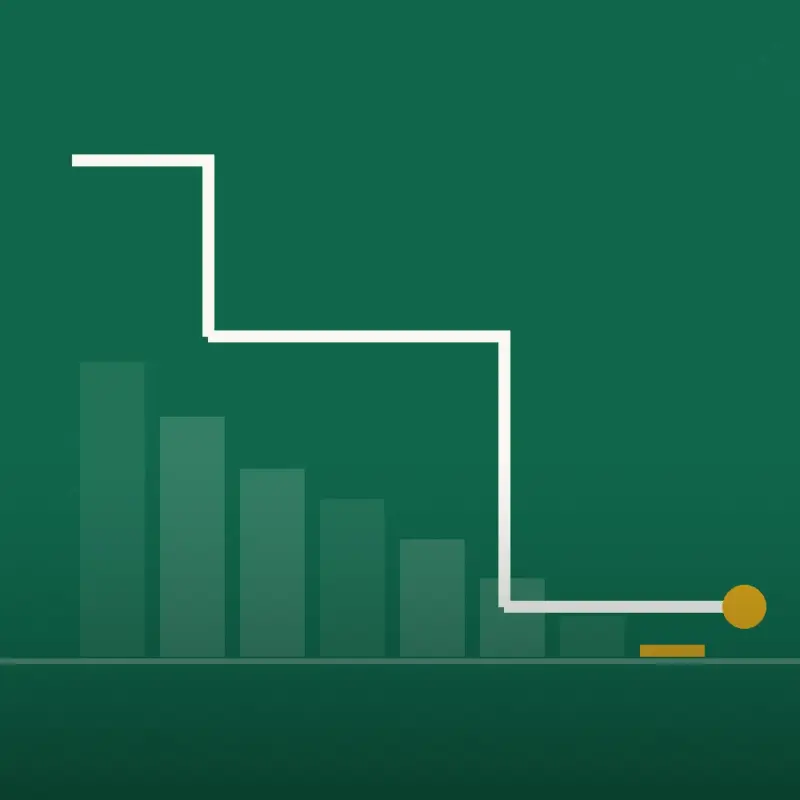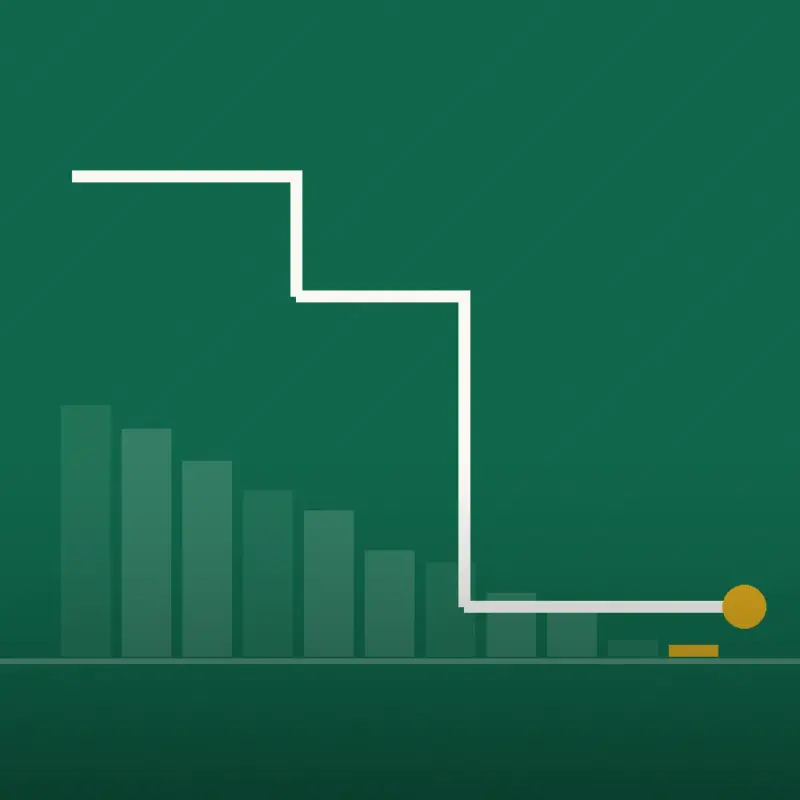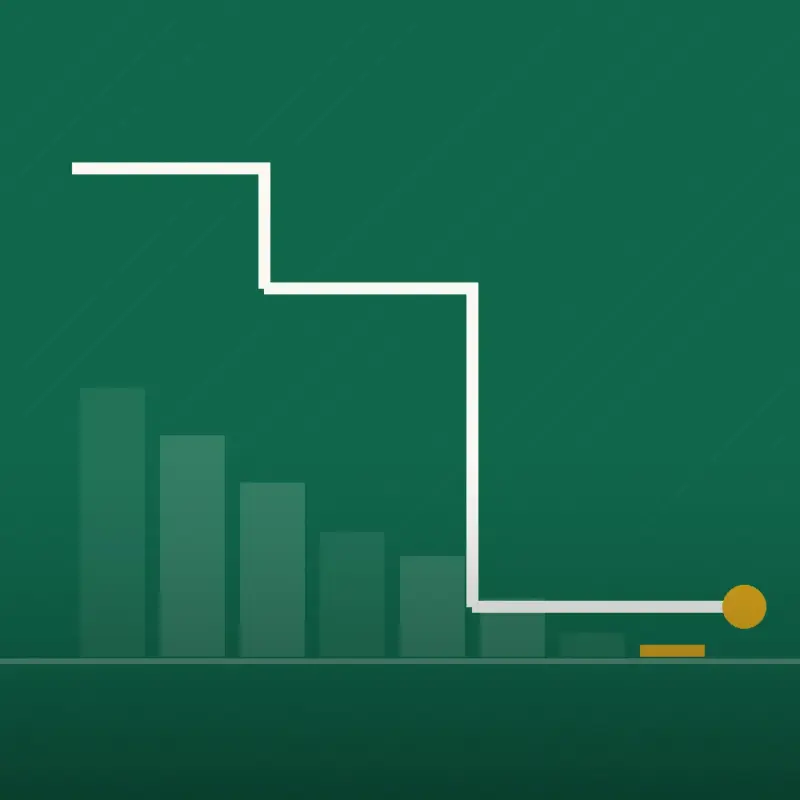
Fast means one of four things, and they are not equally powerful. Raise the payment. Cut the rate. Settle for less than the balance. Or discharge it. On a $20,000 balance, raising the payment from the minimum to $750 a month saves $30,570 and takes 3.3 years. Cutting the rate saves less than people assume. The other two are faster and cost something other than money.
Here is each one, with the number.
Lever 1: The payment amount (worth the most, by far)
$20,000 at 24.99% APR:
| What you pay | Time to zero | Interest |
|---|---|---|
| Minimum (1% of balance + interest) | 28.4 years | $40,062 |
| $500/month | 7.2 years | $23,418 |
| $600/month | 4.8 years | $14,489 |
| $750/month | 3.3 years | $9,492 |
The 24.99% in this table is an assumed rate, chosen because it is round and common, not an observation of anything. Where this page reports a measured rate it names the release and the month; the two sets of numbers should not be read as one series.
Two things in that table are worth staring at. First, the minimum payment is not a slow path to zero, it is a 28-year path that costs twice the original balance. The mechanism is the formula itself: a minimum set at roughly 1% of the balance plus the month’s interest falls as the balance falls, so the payment shrinks in step with the debt and almost all of it goes to interest for years. Second, the gap between $500 and $750 is $13,926. There is no rate negotiation, no transfer offer and no method choice that produces a swing that size.
So the fast version of this question is really: where does another $250 a month come from? In practice, ranked by dollars per hour of effort:
- Recurring charges you would not sign up for today. Streaming, apps, subscription boxes, gym, extra phone lines, extended warranties. Permanent, immediate, no one to negotiate with.
- Insurance re-shop. Auto and renters/home, same coverage, different carrier. One afternoon.
- The cards themselves — lever 2 below.
- Selling one thing of real value rather than ten of small value.
- Income. Genuinely effective and genuinely slow. Every article leads with it because it sounds motivating, but it arrives last.
Lever 2: The interest rate (worth having, worth less than you think)
Three ways to cut the rate, in order of how often they work:
Call and ask for a lower APR. Free, takes fifteen minutes, and a meaningful share of requests get something. Ask specifically: “Is there a lower APR available on this account, or a hardship program I qualify for?” Those are two different products and the second is the stronger one — see credit card hardship programs, issuer by issuer.
A balance transfer to a 0% promotional card. Powerful when you can clear it inside the promo window. Do the arithmetic before applying: $20,000 transferred with a 3% fee costs $600 up front, and clearing $20,600 inside an 18-month promo requires $1,144 a month. If you cannot pay that, the promo expires with a balance and the go-to rate applies. This is the tool’s failure mode, and it is common.
A consolidation loan. This is where most people lose money without noticing, so here is the arithmetic laid bare. $20,000 consolidated over 60 months:
| Loan APR | Monthly payment | Total interest |
|---|---|---|
| 9% | $415 | $4,910 |
| 12% | $445 | $6,693 |
| 15% | $476 | $8,548 |
| 24% | $575 | $14,522 |
Now compare the bottom row to the card itself. Paying $600/month straight to the 24.99% card costs $14,489 in interest — slightly less than consolidating at 24%. A consolidation loan that does not lower your rate does nothing but stretch the term. It feels like progress because there is one payment instead of four, and it is not progress.
The rule, stated plainly: consolidate only if the loan APR is meaningfully below your weighted average card APR, and only if the term is not longer than the payoff you would have managed anyway. Full comparison in balance transfer vs consolidation loan.
Lever 3: Paying less than the full balance
Settlement means a creditor accepts a lump sum for less than what is owed and marks the rest as settled. It is genuinely faster than paying in full and it is not free:
- It generally requires accounts already seriously delinquent or charged off, which means the credit damage happens first.
- Forgiven balances above $600 are typically reported to the IRS on a 1099-C and may be taxable income.
- A settled account is reported as settled for less than the full amount, and that notation stays.
It can still be the right call when the alternative is five more years of interest. How to do it yourself, without paying a company 15–25% of the enrolled balance, is in how settling for less actually works.
Lever 4: Discharge
Chapter 7 bankruptcy discharges qualifying unsecured debt — including credit cards — usually within a few months of filing. It is the fastest exit that exists, it stops collection and lawsuits immediately on filing, and it costs a filing fee, attorney fees where used, and a credit report entry lasting up to ten years from the filing date.
This belongs in an article about speed because it is the answer to “fast” for a specific group: people whose required minimums already exceed what is left after essentials. If that is you, four years of grinding is not the conservative choice — it is the expensive one.
Which one applies to you
Not a list of options — an actual answer:
- Balance under roughly a year of your maximum payment, and you are current? Lever 1 plus a rate-cut call. Nothing else is needed, and every product being advertised to you is unnecessary.
- Good credit, and you can genuinely clear the balance in 18 months? Lever 1 plus a balance transfer. Run the required monthly payment first, not after.
- Rate above 20% and you can only manage the minimum plus a little? Try the hardship program before the consolidation loan. It is free, it does not require credit approval, and it often cuts the rate further than a loan would.
- Minimums exceed what you have after housing, food and transportation? Stop optimizing. A nonprofit credit counseling session (NFCC member, free) or a bankruptcy consultation is the correct next step, and both are free.
The two things that make it slower, not faster
Paying a company to do lever 2 or 3 for you. Debt relief and settlement firms typically charge 15–25% of the enrolled debt. On $20,000 that is $3,000–$5,000 — most of what a hardship program would have saved you for free. See how to tell an advertiser from a counselor.
Continuing to use the card during the payoff. A $20,000 balance at 24.99% accrues about $417 a month in interest. Any new spending is layered on top of that, and it is the reason plans stall at month four without the person understanding why.
What each extra fifty dollars a month actually buys
Raising the payment is the strongest of the four levers, and the advice to raise it is usually given as though every fifty dollars were worth the same. It is not, and the gap between the first fifty and the last is larger than most people would guess. We ran every step of a fifty-dollar ladder at 22.15 percent, the average rate the Federal Reserve measured in May 2026 on card accounts being charged interest, and compared each rung with the one above it.
On ten thousand dollars, going from 200 to 250 dollars a month takes the payoff from 141 months to 74. That one step is worth 67 months. The next step, to three hundred, is worth 21 more. By the time the payment is 700 dollars a month, the term is 17 months and another fifty dollars takes it to 16 — one month, for the same six hundred dollars a year.
The pattern holds at other balances and gets sharper at the bottom of each grid. On five thousand dollars the first rung, from 100 dollars a month upward, is worth 88 months. At the top of that same grid, moving from 700 dollars to seven hundred and fifty is worth nothing at all: both clear the balance in eight months, because months come in whole numbers and there is no room left to save one. On twenty thousand dollars the first rung, from 400 dollars, is worth 47 months and takes the term from 141 to 94.
So the practical version of “raise the payment” is narrower than it sounds, and more encouraging. The value is concentrated at the bottom of the ladder, close to the point where the payment barely covers the month’s interest, which is exactly where people assume their extra fifty dollars is too small to matter. It is where it matters most. Above roughly three times the interest charge, further increases buy months rather than years, and at that point the remaining levers — the rate, a settlement, a discharge — are worth more attention than the payment. The full grid at ten thousand dollars shows where the bottom of the ladder sits, and the calculator takes your own balance.
| Payment on $10,000 | Months at that payment | Months at fifty dollars more | Months saved |
|---|---|---|---|
| $200 | 141 | 74 | 67 |
| $250 | 74 | 53 | 21 |
| $300 | 53 | 41 | 12 |
| $400 | 34 | 29 | 5 |
| $500 | 26 | 23 | 3 |
| $600 | 21 | 19 | 2 |
| $700 | 17 | 16 | 1 |
| $800 | 15 | 14 | 1 |
Where the extra fifty dollars stops being worth much
The shape of that ladder is not a quirk of ten thousand dollars. Interest is charged on the balance, so the term is governed by how much of each payment survives the interest charge, and near the threshold that surviving share is tiny. Add fifty dollars there and you can double or triple the amount actually retiring principal. Add the same fifty dollars to a payment that is already three or four times the interest charge and you have raised the principal share by a few percent, which buys a month.
Two things follow, and the second is the one this page was missing. First, the cheapest speed available to anyone is the first rung, and it does not require credit approval, a product or a phone call. Second, past the middle of the grid the payment lever runs out, and no amount of budget discipline substitutes for a lower rate. That is the honest boundary of lever one, and it is why the formula your minimum payment uses and the rate itself decide the outcome for anyone stuck at the bottom of the ladder.
| Source | Own amortization engine, run at the average APR on credit card accounts assessed interest published by the Board of Governors of the Federal Reserve System, series TERMCBCCINTNS |
|---|---|
| What we asked it | For each fixed monthly payment from $100 to $850 in fifty-dollar steps, the term at that payment and the term at fifty dollars more, on balances of $5,000, $10,000 and $20,000, iterating month by month at one twelfth of the annual rate |
| Data as of | APR observed May 2026; ladders computed September 2, 2026 |
| Retrieved | September 2, 2026 |
| Assumptions | Monthly compounding at the annual rate divided by twelve; a real issuer compounds daily on the average daily balance; no new charges on the account after the first month; no annual fee, late fee or over-limit fee; the payment is applied on the statement date; minimum payment floor of $35, which binds only on the minimum-payment schedules and not on a fixed payment |
| How to repeat it | In a spreadsheet, add balance * 0.2215 / 12 to the balance each month and subtract the payment, then repeat the column with the payment fifty dollars higher. The difference in the row where each column reaches zero is the number of months that fifty dollars bought. |
What this does not say.
- Terms are whole months, so the ladder is not perfectly smooth. On twenty thousand dollars the step above 750 dollars a month buys four months where the step below it buys three, and on five thousand one step buys none at all. Those are rounding boundaries, not a change in the mechanism.
- We publish the months, not the interest saved. What a fixed-payment schedule costs in total depends on how the last, smaller payment is accounted for, and our treatment of that final month is not one we will stand behind to the dollar yet, so we report the term instead.
- Interest is compounded monthly at the annual rate divided by twelve. A real issuer charges on an average daily balance, which shifts a long term by a fraction of a month.
- The rate is one observation of an average, taken in May 2026 on accounts that are being charged interest. Your own rate moves every rung of the ladder, and a higher rate pushes the whole shape to the right.
- The ladder assumes the higher payment is made every month without interruption. A payment held for six months and then abandoned does not buy the months in this table; it buys a fraction of them, and the tables cannot tell you which.
Frequently asked questions
What is the fastest way to pay off credit card debt? Increase the monthly payment as high as your budget genuinely allows, direct all of it to one card while paying minimums on the rest, and cut the rate first if the issuer will do it. At the 22.15% rate measured in May 2026, the first fifty dollars added to a $200 payment on $10,000 takes the payoff from 141 months to 74.
Is paying an extra fifty dollars a month actually worth it? It depends entirely on where you are starting. On $10,000 at 22.15%, adding fifty dollars to a $200 payment saves 67 months; adding it to a $700 payment saves one. The extra fifty is worth the most precisely when the payment is small enough that people assume it cannot matter.
How do I get out of credit card debt when I live paycheck to paycheck? Ask each issuer for its hardship program — reduced APR or temporary lower payments, granted on request, not credit-approved. Then confirm nothing is being paid ahead of housing, utilities and food. If minimums still exceed what remains, the answer is a free nonprofit counseling session, not a payoff method.
Can I get out of credit card debt with bad credit? Yes, but not through the credit-dependent tools. Balance transfers and low-rate consolidation loans require good credit; hardship programs, debt management plans through a nonprofit agency, DIY settlement and bankruptcy do not. Bad credit removes the cheapest options, not the exits.
Will paying off credit card debt raise my credit score? Usually yes, and often quickly, because it lowers your utilization ratio — one of the fastest-moving scoring factors. Do not close the accounts afterward; the available limit is what keeps utilization low.
This article explains how credit card payoff works and what each approach costs. It is not individual financial advice and not tax advice. Rates and program terms differ by issuer and change over time; the arithmetic here is calculated at a stated 24.99% APR and is reproducible.
Sources
- Federal Reserve G.19 Consumer Credit — average credit card APR
- CFPB — credit card agreements database (find your issuer’s terms)
- FTC — How To Get Out of Debt (what debt settlement programs actually require)
- Board of Governors of the Federal Reserve System — Commercial bank interest rate on credit card plans, accounts assessed interest (TERMCBCCINTNS), observation of May 2026 (accessed 2026-09-02)
Information, not advice. How we calculate, source and review this — and what we do not do — is set out on our methods and sourcing page.