A $20,000 credit card balance at 24.99% APR, paid at the minimum, takes 28.4 years to clear and costs $40,062 in interest. You pay $60,062 for $20,000.
That is not a scare figure. It is arithmetic, and you can reproduce it. Here is how it works and why the box on your statement may say something different.
What minimums do at every balance
At 24.99% APR, with a minimum of 1% of the balance plus interest and a $35 floor:
| Balance | Time to zero | Interest paid | Total paid |
|---|---|---|---|
| $5,000 | 16.9 years | $8,824 | $13,824 |
| $10,000 | 22.7 years | $19,237 | $29,237 |
| $15,000 | 26.0 years | $29,649 | $44,649 |
| $20,000 | 28.4 years | $40,062 | $60,062 |
| $30,000 | 31.8 years | $60,887 | $90,887 |
Every row pays more in interest than the original amount borrowed. And notice the shape: doubling the balance from $10,000 to $20,000 adds under six years to the timeline but more than doubles the interest. The mechanism punishes size disproportionately.
Why it works this way
The minimum payment is designed to fall as the balance falls. On $20,000 at 24.99%:
- Interest for the month: about $417
- Minimum payment: about $617 (interest plus 1% of the balance)
- Principal reduction: about $200
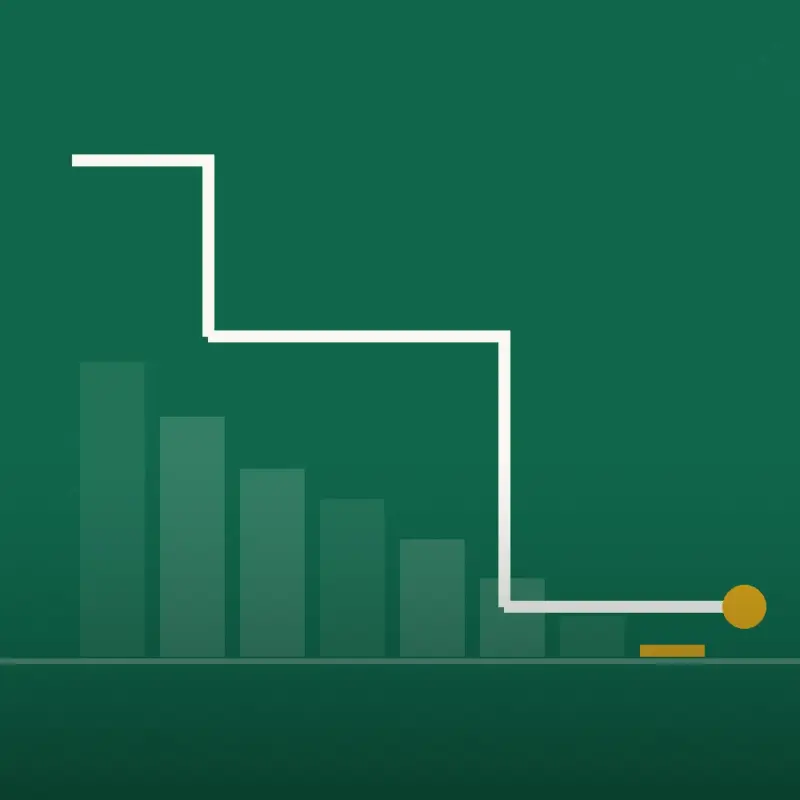
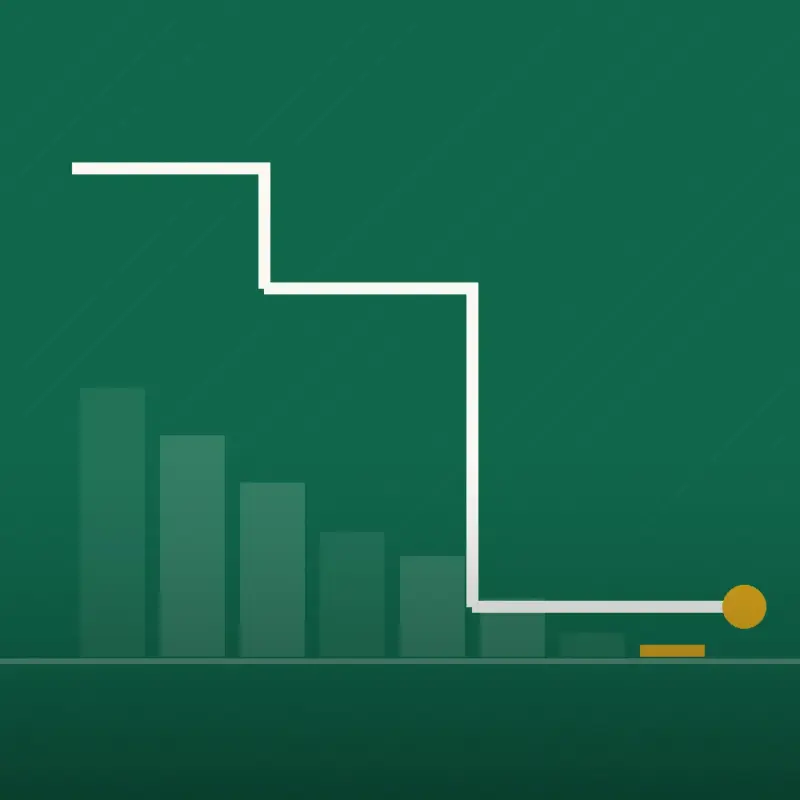
So roughly two-thirds of your payment services the interest, and the third that reduces principal shrinks every month, because 1% of a smaller balance is a smaller number. The payment declines in step with the balance, which is exactly what stretches the timeline across decades.
This is why the balance seems not to move. It is moving — at about 1% per month, minus nothing, against 2.08% monthly interest applied to the whole thing.
The detail nobody explains: there are two formulas
Your statement’s payoff estimate may not match any online calculator, and both can be right. Two structures are in common use:
- Interest plus 1% of the balance, with a floor around $35. Used in the table above.
- A flat percentage of the balance, often 2%, with interest included within it.
On the same $20,000 at 24.99%:
| Formula | Time to zero | Interest |
|---|---|---|
| Interest + 1% of balance | 28.4 years | $40,062 |
| 2% of balance | Never clears | Grows |
They are not two speeds, they are two outcomes. At this rate one month of interest on $20,000 is $416.50 and a flat 2% of the balance is $400, so the flat-percentage minimum never covers the interest and the balance does not come down. Both formulas are in use; only one of them is a route to zero. Which one applies to you is in your cardholder agreement, and it is worth finding.
Your formula is stated in your cardholder agreement. It is worth finding, because it determines whether your minimum payment is a slow path or a nearly endless one. It also explains the “minimum payment vs statement balance” confusion — the minimum is a calculated obligation, the statement balance is what you actually owe, and paying the statement balance in full is the only way to avoid interest entirely.
The warning box on your statement
Federal law requires card statements to show how long it would take to pay off the balance making only minimum payments, and what a payment sized to clear it in three years would be.
Read that second number. It is the single most useful figure on the statement and it is placed where nobody looks. For $20,000 at 24.99%, the three-year payment is roughly $795 — and paying it costs about $9,000 in interest instead of $40,000.
Getting out of it
Two moves, in order of impact:
1. Fix the payment, not the balance. Set a fixed monthly amount and do not let it fall as the balance does. That single change is most of the escape:
| Fixed payment on $20,000 | Time | Interest | Saved vs minimums |
|---|---|---|---|
| $500 | 7.2 years | $23,418 | $16,644 |
| $600 | 4.8 years | $14,489 | $25,573 |
| $750 | 3.3 years | $9,492 | $30,570 |
2. Cut the rate. At $417 a month in interest, a rate reduction is worth real money here. An issuer hardship program is free and requires no credit approval. See cutting the rate for free.
Do them in that order. The fixed payment works without anyone’s permission; the rate cut requires a phone call that may or may not succeed.
The one thing that makes it worse
Continuing to spend on the card. New purchases are added to a balance already growing at $417 a month, and because minimum payments scale to the balance, the payment rises just enough to feel like you are keeping up.
If you take one thing from this page: a fixed payment on a frozen card is the difference between 28 years and three. Worked plans at the two most common balances: the plan that beats it at $20,000 and the 27-month plan at $10,000. Or see it for your own balance.
One minimum formula clears the balance in 266 months. The other never does
Both of the minimum-payment formulas in common use are correct arithmetic, and they are nowhere near each other. We put the same ten thousand dollar balance through each one at 22.15 percent — the rate the Federal Reserve measured in May 2026 on card accounts assessed interest — and let each schedule run until the balance reached zero or a hundred years passed, whichever came first. Interest plus one percent of the balance clears it in 266 months and costs $16,960 in interest, so ten thousand borrowed becomes $26,960 repaid: 2.7 times the balance. A flat two percent of the balance does not clear it at all.
The mechanism is a race between two percentages and it is settled in the first month. At the measured rate, one month of interest on ten thousand dollars is a little over a hundred and eighty dollars. The interest-plus-one-percent formula asks for that interest and a hundred dollars on top, so a hundred dollars comes off the balance. The flat two percent formula asks for two hundred dollars in total, and once the interest is covered there is about fifteen dollars left to reduce the debt. Same balance, same rate, same month, and one formula is retiring principal several times faster than the other.
What rescues the flat-percentage formula at small balances is the payment floor, not the percentage. Two percent of the balance stops covering the month’s interest long before the balance reaches zero, and from there the fixed thirty-five dollar floor is what pays the debt down — at the point where it takes over, the month’s interest is more than thirty-two of those thirty-five dollars. That is still enough on two thousand dollars, which clears in 227 months. On five thousand it takes 821. On ten thousand and above the schedule is still open when our horizon of 1,200 months runs out, so we report no payoff date rather than inventing one.
The practical consequence is not a rate question. Your cardholder agreement states which of the two formulas your issuer uses, and that one line decides whether the minimum is a slow path to zero or no path at all. If it is the flat-percentage kind, paying the minimum more diligently does not help; fixing the payment in dollars, so that it stops falling as the balance falls, is the only move that changes the arithmetic.
| Balance | Interest + 1%: months | Interest under that formula | Flat 2%: months | Interest under that formula |
|---|---|---|---|---|
| $2,000 | 106 | $2,193 | 227 | $6,148 |
| $5,000 | 197 | $7,731 | 821 | $42,066 |
| $10,000 | 266 | $16,960 | not cleared in 1,200 | $100,855 and still owing |
| $15,000 | 307 | $26,189 | not cleared in 1,200 | $151,396 and still owing |
| $20,000 | 335 | $35,418 | not cleared in 1,200 | $201,861 and still owing |
| $30,000 | 376 | $53,876 | not cleared in 1,200 | $302,792 and still owing |
Why the payment floor, not the balance, decides the flat-percentage outcome
Every row above is one run of an amortization loop rather than a lookup: apply one twelfth of the annual rate to the balance, apply whichever payment the formula demands, repeat. Nothing is sampled and nothing is interpolated, which is why the figures reproduce to the cent and why the horizon has to be stated rather than assumed. Five assumptions do all the work and all five are in the box below, including the one that matters most here, which is the thirty-five dollar floor.
One result deserves separating from the rest, because it contradicts the intuition that a larger balance is simply a longer version of a smaller one. Under the flat-percentage formula it is not a longer version, it is a different outcome: two thousand dollars clears, five thousand takes 821 months, and ten thousand never reaches a payoff date. The threshold is not the size of the debt. It is whether the percentage still covers the month’s interest, and that depends only on the rate — above twenty-four percent a year, a two-percent minimum cannot cover it at any balance at all.
| Source | Own amortization engine, run at the average APR on credit card accounts assessed interest published by the Board of Governors of the Federal Reserve System, series TERMCBCCINTNS |
|---|---|
| What we asked it | The same balance under each of two minimum-payment formulas — the month’s interest plus 1% of the balance, and a flat 2% of the balance — both with a $35 payment floor, iterated month by month until the balance reaches zero or 1,200 months pass, for six balances from $2,000 to $30,000 |
| Data as of | APR observed May 2026; schedules computed September 2, 2026 |
| Retrieved | September 2, 2026 |
| Assumptions | Monthly compounding at the annual rate divided by twelve; a real issuer compounds daily on the average daily balance; no new charges on the account after the first month; no annual fee, late fee or over-limit fee; the payment is applied on the statement date; minimum payment floor of $35 |
| How to repeat it | Take the balance, add one twelfth of 22.15 percent of it as that month’s interest, subtract the payment the formula demands, and repeat. The month count and the interest total follow from those three lines and nothing else, so any spreadsheet reaches the same figures. |
What this does not say.
- The engine stops at 1,200 months. A schedule still open at that point is reported as not clearing, which is a statement about our horizon and not a proof that it never would.
- These are formulas, not issuers. We did not survey card agreements, and nothing here says which formula any particular card or bank uses — that is in your own agreement and nowhere else.
- Interest is compounded monthly at the annual rate divided by twelve. A real issuer charges on an average daily balance, which moves the interest total by a few dollars and the term by a fraction of a month.
- The rate is a single observation of an average, taken in May 2026. Your own rate is the one in your agreement, and above twenty-four percent a year a two-percent minimum stops covering the interest at every balance.
- The tables earlier on this page are worked at a stated rate of just under twenty-five percent as an illustration; these are at the measured rate. The two sets are not interchangeable and should not be read as one series.
Frequently asked questions
What happens if I only pay the minimum on my credit card? The balance falls very slowly because most of the payment covers interest. On $10,000 at the 22.15% average the Federal Reserve measured in May 2026, a minimum of interest plus 1% of the balance takes 266 months and costs $16,960 in interest — more than one and a half times the original balance.
How is the minimum payment calculated? Usually either the month’s interest plus about 1% of the balance with a small floor, or a flat percentage of the balance such as 2%. Which one your issuer uses is stated in your cardholder agreement, and at $10,000 the two do not even agree that the debt gets paid off.
Does a 2% minimum payment ever pay off a credit card? Only while 2% of the balance is still more than the month’s interest, and then only because the fixed dollar floor takes over at the end. At 22.15% we measured $2,000 clearing in 227 months and $5,000 in 821, while $10,000 was still open after 1,200 months, which is where we stop counting.
How much of my minimum payment goes to interest? On a $20,000 balance at 24.99%, roughly $417 of a $617 minimum — about two-thirds. The share rises with the rate, and under a flat-percentage minimum it can reach the whole payment, at which point the balance stops moving at all.
Why is my credit card balance not going down? Because the minimum payment reduces principal by a small percentage of the balance while interest is charged on all of it. Paying a fixed dollar amount instead of the declining minimum is what breaks that pattern, and it is the only move that works without anyone’s approval.
Does paying the minimum hurt my credit score? Paying the minimum on time protects your payment history, so it is far better than paying late. But it keeps your balance and therefore your utilization high, which does hold the score down for as long as the balance stays there.
What is the difference between the minimum payment and the statement balance? The minimum is the least you can pay without being late. The statement balance is the full amount owed as of the statement date, and paying that in full is what avoids interest altogether.
Why does my statement’s payoff estimate differ from an online calculator? Because your statement uses your card’s actual minimum payment formula and the calculator uses whichever one it was built around. The two formulas in common use produce results hundreds of months apart on the same balance, so a mismatch is usually a difference of formula rather than an error.
Arithmetic here is calculated at a stated 24.99% APR under each minimum-payment formula and is reproducible. Your issuer’s formula and rate will change the figures; both are in your cardholder agreement. Not individual financial advice.
Sources
- CFPB — credit card minimum payment warnings and CARD Act disclosure requirements
- Your cardholder agreement (the minimum payment formula is stated in it)
- Federal Reserve G.19
- Board of Governors of the Federal Reserve System — Commercial bank interest rate on credit card plans, accounts assessed interest (TERMCBCCINTNS), observation of May 2026 (accessed 2026-09-02)
- 12 CFR 1026.7(b)(12) — the minimum payment disclosure that card statements are required to carry (accessed 2026-09-02)
Information, not advice. How we calculate, source and review this — and what we do not do — is set out on our methods and sourcing page.