$500 a month clears $10,000 at 24.99% in 27 months and costs $3,069 in interest. Minimum payments take 22.7 years and cost $19,237. At this balance the gap between doing it deliberately and drifting is about $16,000 and two decades.
The 27 months in the headline is worked at a stated 24.99%. At the rate this site actually measured — 22.15%, the Federal Reserve average for May 2026 — the same $500 clears the same balance in 26 months and costs $2,595 in interest. Both are correct arithmetic; they answer one question at two different rates, and the section below uses the measured one. Why both rates appear.
$10,000 also happens to be the size where the cheapest tool in credit cards actually works.
The four outcomes
| Monthly payment | Time to zero | Interest |
|---|---|---|
| Minimum (1% + interest) | 22.7 years | $19,237 |
| $250 | 87 months (7.3 years) | $11,709 |
| $300 | 58 months (4.8 years) | $7,245 |
| $400 | 36 months | $4,270 |
| $500 | 27 months | $3,069 |
Calculated at 24.99% APR as a stated example, with the minimum payment modelled as 1% of the balance plus interest and a $35 floor. That floor matters more than it looks: it is what stops the tail of a minimum-payment schedule running on almost indefinitely, so it is stated here rather than left implicit. Run your own balance.
The step from $250 to $500 is worth $8,640 and five years — the single highest-return decision on this page.
Why a balance transfer is realistic here and not at $20,000
This is the practical difference between a $10,000 problem and a $20,000 one.
$10,000 transferred with a 3% fee means you owe $10,300 at 0%. To clear it inside an 18-month promo you need about $572 a month. Inside 21 months, about $491.
Compare: the same exercise on $20,000 requires $1,144 a month at 18 months — out of reach for most households, which is why the product so often fails at larger balances.
At $10,000, if you can pay roughly $500–$575 a month and you have good credit, a 0% transfer eliminates the entire $3,069 of interest. That is the best available outcome and it is genuinely achievable at this size.
Three conditions before you apply:
- The credit limit must cover the balance. Approval does not guarantee a $10,000 limit.
- Make the transfer inside the deadline — often 60 to 120 days from opening — or you lose the promotional rate.
- Do not spend on the new card. Purchases can carry a different rate and a different end date.
Details: how the transfer math works.
If your credit will not support a transfer
Two free moves first:
Ask each issuer for its hardship program. No credit check, granted on request, and it cuts the rate on the debt you already have. See cutting the rate for free.
Then check whether a consolidation loan actually helps. At $10,000 the loan needs to be meaningfully below your card rate to beat simply paying $500 a month — which already costs only $3,069. At this balance, a mediocre loan offer is easily worse than a disciplined fixed payment, because the fixed payment is already fast.
Finding $500 a month
At this balance you need less than most articles assume. Typical sources, in order of speed:
- Subscriptions and recurring services you would not re-buy today: commonly $80–$200 a month, permanently.
- Insurance re-shop — auto and renters, same coverage: often $30–$100 a month.
- Phone and internet retention pricing: $20–$50.
- Food delivery and takeout, which is frequently the largest discretionary line in a household carrying this balance.
- A tax refund, if one is coming. On $10,000 a single $3,000 refund applied to the balance cuts months off and saves hundreds in interest.
That list gets most households to $300–$400 without new income. The remainder is usually a matter of timing rather than sacrifice.
If it is spread across several cards
Send minimums to all and everything extra to one. Highest rate first if you have never abandoned a payoff plan; smallest balance first if you have. The difference is about $998 on a typical four-debt portfolio — worth having, not worth deliberating. See which card first, if it is spread across several.
When $10,000 is more serious than it sounds
Two situations where the number understates the problem:
Your limits are close to fully used. $10,000 across $11,000 of limits means utilization near 90%, which suppresses your score and closes off the transfer option — the cheapest tool becomes unavailable precisely because of the balance.
It is one of several debts. $10,000 in cards alongside a car loan and student loans can push total required payments past 40% of income. At that point the relevant test is your overall debt-to-income ratio, not this balance.
Ten thousand dollars at 22.15 percent, payment by payment
Here is the whole grid for ten thousand dollars at 22.15 percent, the average rate the Federal Reserve measured in May 2026 on card accounts that are being charged interest. It begins with a figure that is not a payment level at all. In the first month, interest on ten thousand dollars at that rate is $184.58. A payment at or below that leaves the balance where it was or higher, so the fifty, hundred and hundred-and-fifty dollar rows of the grid have no payoff date to report. Not a long one. None.
Just above the threshold the grid opens up very fast. $200 a month clears the balance in 141 months. $250 clears it in 74. The single largest improvement available anywhere in this grid is that first step of fifty dollars, and it is taken apart step by step in what each extra fifty dollars a month buys.
Higher up, the returns flatten in a way most people do not expect, because the term is not proportional to the payment. Doubling from $250 to $500 does not halve 74 months; it cuts them to 26, roughly a third. Doubling again, from five hundred to a thousand dollars a month, takes those 26 months down to twelve. The first fifty dollars is worth years, the last five hundred is worth a bit over a year, and the whole shape of that curve is a consequence of interest being charged on the balance rather than on the payment.
What this changes about the plan on the rest of this page: the question is not what payment would be ideal, it is which side of $184.58 you are on this month and how far above it you can get. If the honest answer is that you are near the line, the rate is the lever rather than the payment — a free issuer hardship program moves the threshold down, and the minimum payment formula in your agreement decides whether the minimum was ever going to get there.
| Monthly payment | Months to clear | In years and months |
|---|---|---|
| $50 | no payoff date | below the first month's interest |
| $100 | no payoff date | below the first month's interest |
| $150 | no payoff date | below the first month's interest |
| $200 | 141 | 11 years 9 months |
| $250 | 74 | 6 years 2 months |
| $300 | 53 | 4 years 5 months |
| $400 | 34 | 2 years 10 months |
| $500 | 26 | 2 years 2 months |
| $600 | 21 | 1 year 9 months |
| $750 | 16 | 1 year 4 months |
| $1,000 | 12 | 1 year |
The payment threshold, and why the grid has three empty rows
The empty rows are the most useful part of the table, so they are printed rather than hidden. Our engine takes a balance, adds one twelfth of the annual rate as that month’s interest, subtracts the payment and repeats. If the payment never exceeds the interest, the loop has nothing to converge on: the balance is flat or growing, and there is no term to return. Rather than print a very large number and let it look like an answer, the engine returns no schedule and we print the gap.
The threshold is worth carrying around, because it scales with the balance and is trivial to compute for your own. It is one twelfth of your rate applied to your balance, and nothing else. On five thousand dollars at the measured rate it is under a hundred dollars a month; on thirty thousand it is $553.75, which is more than most households treat as an aggressive payment. That is the arithmetic behind the common experience of paying every month for a year and watching the balance not move: the payment was real, and it was under the line.
| Source | Own amortization engine, run at the average APR on credit card accounts assessed interest published by the Board of Governors of the Federal Reserve System, series TERMCBCCINTNS |
|---|---|
| What we asked it | A $10,000 balance at eleven fixed monthly payments from $50 to $1,000, iterated month by month at one twelfth of the annual rate until the balance reaches zero, plus the first month’s interest at each of six balances to locate the payment threshold |
| Data as of | APR observed May 2026; schedules computed September 2, 2026 |
| Retrieved | September 2, 2026 |
| Assumptions | Monthly compounding at the annual rate divided by twelve; a real issuer compounds daily on the average daily balance; no new charges on the account after the first month; no annual fee, late fee or over-limit fee; the payment is applied on the statement date; minimum payment floor of $35, which applies to the minimum-payment rows rather than to a fixed payment |
| How to repeat it | In a spreadsheet, put the balance in the first cell, add balance * 0.2215 / 12, subtract the payment, and fill down until the column goes to zero. The row number where it does is the term, and it will match ours to the month. |
| Balance | Interest in month one | Lowest payment on our grid that reduces it |
|---|---|---|
| $5,000 | $92.29 | $100 |
| $10,000 | $184.58 | $200 |
| $15,000 | $276.88 | $300 |
| $20,000 | $369.17 | $400 |
| $30,000 | $553.75 | $600 |
What this does not say.
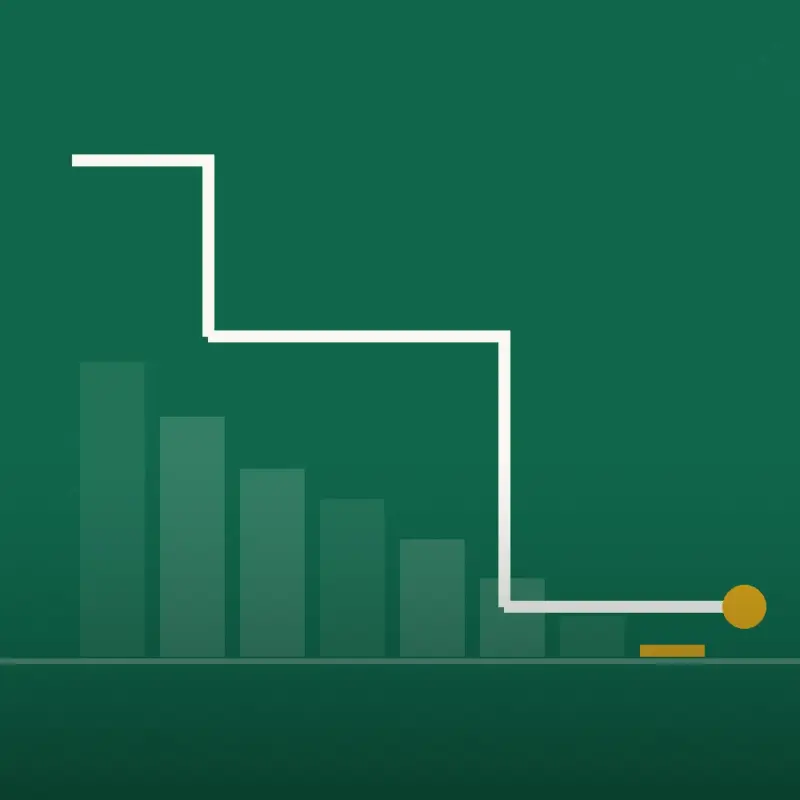
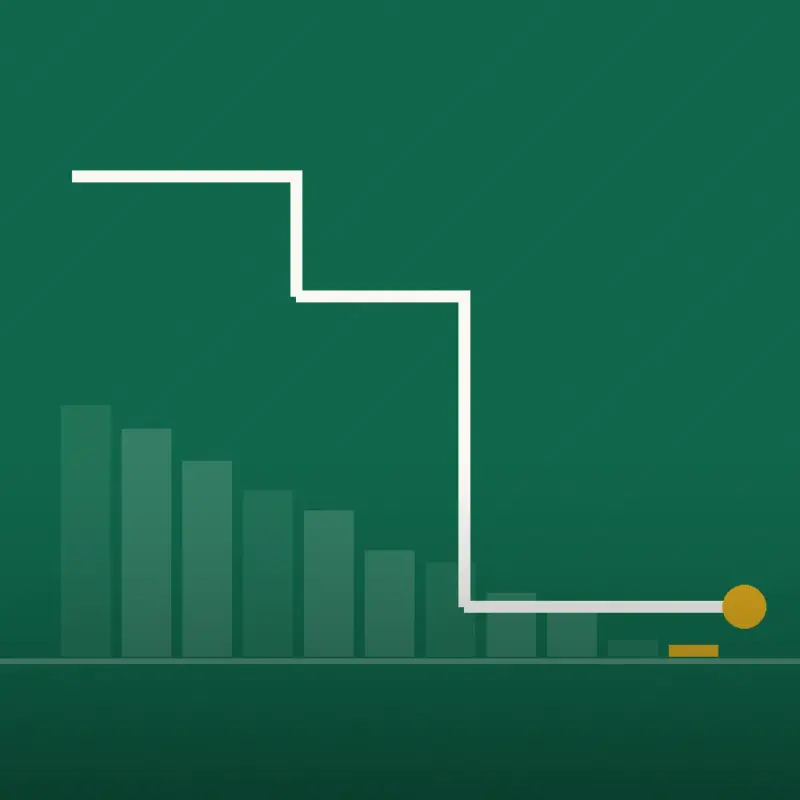
- Three rows of the grid have no term at all because the payment does not cover the first month’s interest. That is a real result, not missing data, and it is why the chart has eight bars rather than eleven.
- We publish the term, not the total interest. What a fixed-payment schedule costs in total depends on how the final, smaller payment is accounted for, and our treatment of that last month is not one we will stand behind to the dollar yet, so the column is absent rather than approximate.
- Interest is compounded monthly at the annual rate divided by twelve. A real issuer charges on an average daily balance, which moves a term of this length by a fraction of a month.
- The rate is a single observation of an average, taken in May 2026, on accounts that are being charged interest. It is not your rate, and every figure in the grid moves with the rate you actually hold.
- No fees, no new charges and no missed payments are modelled. A single new purchase resets the threshold upward, which is the most common reason a real payoff runs longer than a grid like this one.
Frequently asked questions
How long does it take to pay off $10,000 in credit card debt? At the 22.15% average the Federal Reserve measured in May 2026: 141 months at $200 a month, 74 months at $250, 34 at $400, 26 at $500 and 12 at a thousand a month. Below about $185 a month the balance does not fall at all, because that is what one month of interest costs.
What if I can only pay $200 a month? It works, barely. The first month’s interest on $10,000 at 22.15% is $184.58, so $200 leaves about fifteen dollars against the balance and the payoff takes 141 months. That is the signal to go after the rate first, through a free issuer hardship program, rather than to grind at the payment.
How much interest will I pay on $10,000 in credit card debt? On minimum payments, about $19,237 at a stated 24.99% — nearly twice the balance. At $500 a month, $3,069. With a successful 0% balance transfer cleared inside the promotional period, just the transfer fee.
Is a balance transfer worth it for $10,000? Usually yes, if your credit qualifies and you can pay about $572 a month to clear $10,300 inside an 18-month promo. That eliminates the interest entirely for a $300 fee, and $10,000 is roughly the largest balance at which the required payment stays realistic.
Arithmetic here is calculated at a stated 24.99% APR and is reproducible. Not individual financial advice.
Sources
- CFPB — credit card payoff and balance transfers
- Federal Reserve G.19
- Board of Governors of the Federal Reserve System — Commercial bank interest rate on credit card plans, accounts assessed interest (TERMCBCCINTNS), observation of May 2026 (accessed 2026-09-02)
- CFPB — How does my credit card company calculate the amount of interest I owe? (accessed 2026-09-02)
Information, not advice. How we calculate, source and review this — and what we do not do — is set out on our methods and sourcing page.