It is about ten minutes long, it is run by a trustee rather than a judge, it takes place in a conference room or over video rather than a courtroom, and in most consumer cases no creditor appears at all. It is called a meeting of creditors, which is the most misleading name in consumer bankruptcy.
It is required. Missing it can get your case dismissed. And it is far less adversarial than the name suggests.
What it is for
The trustee has your schedules and needs to confirm, under oath, that they are accurate and complete — and to identify anything of value the estate could realize for creditors. That is the entire purpose.
Not a defense of your finances. Not a judgment on your decisions. A verification of paperwork.
The standard questions
Nearly every 341 meeting covers the same ground, and trustees are required to establish certain points. Expect versions of these:
- Is this your signature on the petition?
- Did you read the petition and schedules before signing, and are they true and complete?
- Are there any errors or omissions you want to correct today?
- Have you listed all your assets and all your creditors?
- Have you filed all required tax returns?
- Have you transferred, sold or given away any property in the last year or two?
- Have you ever filed bankruptcy before?
- Do you expect to receive any money — an inheritance, a lawsuit settlement, a tax refund?
- Do you own or have any interest in real estate?
- Has anything changed since you filed?
Answer briefly and truthfully. “I don’t remember” and “I’d need to check” are acceptable answers. Guessing is what causes problems, because you are under oath.
What to bring
- Photo ID and proof of your Social Security number. Bring both; a missing ID is a real and frequent reason for a meeting to be continued.
- Any documents the trustee requested in advance — tax returns, pay stubs, bank statements.
- Anything that changed since filing, in writing.
Check your district’s instructions on format. Since 2020, telephonic and video meetings have become common in many districts and the requirements for identity verification differ from an in-person appearance. Confirm your own district’s current practice rather than assuming.
What creditors do, when they come
Almost always: nothing. They receive notice and do not attend, because there is nothing to gain in a typical no-asset case.
When one does appear, it is usually one of these:
- A car or furniture lender, asking what you intend to do with the collateral.
- A creditor with a recent large balance, probing whether the debt was incurred with no intention to repay.
- An ex-spouse or business partner, where there is a dispute about property.
Their questions are limited to your financial affairs and the administration of the estate. They do not get to lecture you.
The horror stories, honestly
Since that is what a lot of people are searching for: the meetings that go badly go badly for reasons that are predictable, and mostly avoidable.
- Undisclosed assets surface. A second vehicle, a side business, a bank account, a pending lawsuit, cash. This is the main one, and it is entirely a function of what went on the schedules.
- A recent transfer comes up. Paying back a relative, retitling a car, moving money before filing. Trustees can unwind these.
- Filing without an ID, or with a name mismatch, so the meeting is continued and everything is delayed.
- The schedules are visibly wrong — a house valued at half its market value, income that does not match the pay stubs.
- Arriving unprepared to explain something unusual, such as a large recent purchase.
None of these is about being poor or being judged. All of them are about the accuracy of the paperwork, which is also why the exemptions the trustee is checking are worth getting right before this day.
If you miss it
Do not. A missed meeting is typically rescheduled once, and a second miss can lead to dismissal of the case — which means no discharge and the automatic stay ends, with creditors free to resume.
If something genuinely prevents attendance, contact the trustee’s office before the meeting.
After it ends
The trustee declares the meeting concluded. In a no-asset case, that is effectively the last thing that happens before the discharge arrives — typically a couple of months later, after the deadline for objections passes. You also need to complete the required debtor education course and file its certificate.
See what comes after the meeting.
How many of these meetings the courts actually hold in a year
Every bankruptcy case gets one of these meetings, which makes the size of the calendar knowable. We took Table F-2 from the Administrative Office of the U.S. Courts for the twelve months ending in June 2026 and added up the district rows: 608,511 filings across 93 bankruptcy districts. That is an average of 6,543 cases per district in a year, and each one had a meeting of creditors scheduled on somebody’s calendar.
The split by chapter decides what the meeting is for. 382,161 of those filings were Chapter 7 — 62.8% of the total — where the trustee is checking the schedules and looking for property the estate could realize. 215,490 were Chapter Thirteen, 35.4%, where the same sitting is the first step toward confirming a repayment plan. 581,570 of all filings were consumer cases rather than business ones, so the ordinary version of this meeting is by a wide margin the common one.
The load is not spread evenly. The Central District of California alone took 32,188 filings, nearly five times the average district; the Middle District of Florida took 29,567 and the Northern District of Illinois 23,071. If you are filing in one of those, your meeting is one slot in a block the trustee works through in a single session. That is not a judgment about your case. It is arithmetic, and it explains the conference-room feel better than anything in the statute does.
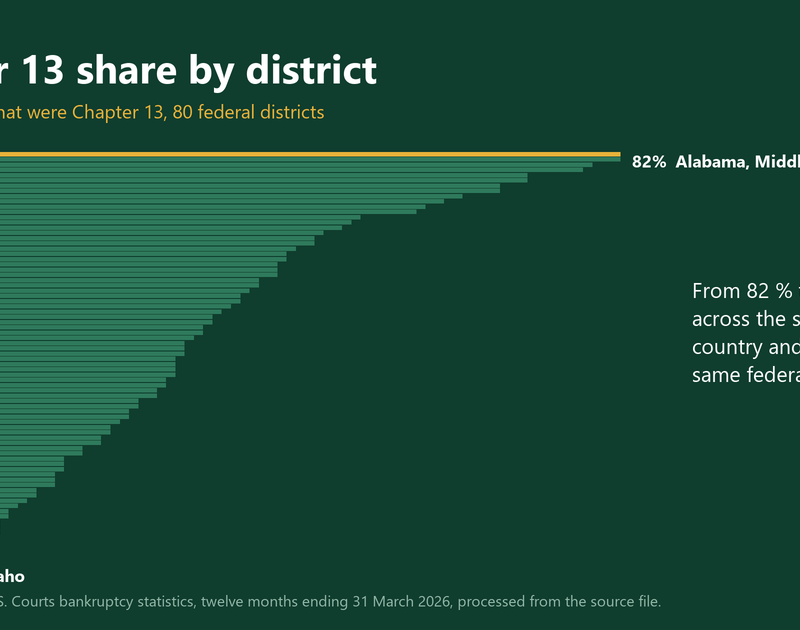
Which chapter dominates is a local pattern rather than a national one, and it changes what happens after the meeting rather than during it — we measured that separately in the Chapter Thirteen share by district. The purpose of the sitting itself does not vary: verify the paperwork, under oath, and identify anything of value.
| District | All filings | Chapter 7 | Chapter 13 |
|---|---|---|---|
| Central District of California | 32,188 | 27,137 | 4,514 |
| Middle District of Florida | 29,567 | 22,851 | 6,108 |
| Northern District of Illinois | 23,071 | 13,256 | 9,578 |
| Northern District of Georgia | 22,619 | 12,604 | 9,649 |
| Eastern District of Michigan | 19,464 | 13,308 | 6,036 |
| Southern District of Florida | 16,944 | 9,610 | 6,815 |
| Northern District of Ohio | 14,960 | 12,263 | 2,628 |
| District of New Jersey | 14,843 | 9,060 | 5,047 |
| All 93 districts | 608,511 | 382,161 | 215,490 |
Why the calendar is fuller than it was a year ago
The same table a year earlier, for the twelve months ending in June 2025, counted 542,529 filings. The docket grew 12.2% in twelve months, and Chapter 7 grew faster than the whole: from 333,321 to 382,161, up 14.7%.
That is a measured change in volume and nothing more. It does not say trustees are slower, that sessions are longer, or that your meeting is more likely to be continued — the table counts cases filed, not minutes spent or sittings held. What it does support is narrower and more useful: the routine reasons a meeting gets continued, and a missing photo ID is the most common of them, now cost you a rescheduled date on a fuller calendar than they would have last year.
The practical consequence is about preparation rather than nerves. In a session of this shape the trustee has your schedules in front of them and a queue behind you, so the questions are the standard ones and the answers that cause trouble are the guessed ones. If you are filing on your own, the schedules are what is being read in those ten minutes — see which schedule is worth getting right — and if you are still choosing a chapter, the difference shows up mostly after this date rather than at it: how the two chapters diverge.
How we counted, and the five things a filing count cannot tell you
One source, one arithmetic step. We read the official workbook for Table F-2 rather than the PDF, summed the district rows, and compared our sum with the national total the court prints on the same sheet. The two agree exactly, with no district off by a single case in either period, which is the only check this measurement admits.
The chapter shares are ours. The court publishes the counts; the percentages, the per-district average and the year-on-year change are calculations on top of them, and any of them can be rebuilt from the two workbooks in a few minutes.
| Source | Administrative Office of the United States Courts, Table F-2, Bankruptcy Filings by District, read from the official XLSX workbook rather than the PDF |
|---|---|
| What we asked it | We summed the 93 district rows of the F-2 for the twelve months ended June 30, 2026, checked the sum against the national total printed on the same sheet, and repeated both steps on the F-2 for the twelve months ended June 30, 2025 to get the year-on-year change. |
| Data as of | Twelve months ended June 30, 2026, compared with the twelve months ended June 30, 2025 |
| Retrieved | September 2, 2026 |
| Assumptions | One filing is counted as one scheduled meeting of creditors; that is the court’s case count, not a count of sittings actually held; district rows include business filings, which the table reports in the same rows and which we did not strip out of the district totals; the two periods are the court’s own twelve-month reporting windows, and the later table covers one district more than the earlier one |
| How to repeat it | Download the F-2 workbook for the period from the court’s own data tables page, add the district rows, and compare your sum with the printed national total on the sheet; then do the same for the previous year’s workbook. |
What this does not say.
- A filing is not a meeting held. The table counts cases opened, and one case can produce no sitting at all if it is dismissed early, or two or three if the meeting is continued. Nothing here measures how many sittings a trustee actually ran.
- The window closes at the end of June 2026. Anything filed since is not in these counts, and the court republishes the table every quarter.
- The table has no field for how a meeting went, who attended, how long it took or whether the case was later dismissed. No number on this page says anything about your own hearing.
- District rows mix consumer and business cases. Business filings are a small share of the total but they are administered differently, so a district total is a docket size rather than a count of ordinary consumer meetings.
- The later table covers 93 districts and the earlier one 92, so the year-on-year figure is the change in the national total the court printed rather than a strictly like-for-like district panel.
Frequently asked questions
How long does a 341 meeting last? Usually five to fifteen minutes. Trustees schedule many in a single session, and a straightforward consumer case moves quickly. With 608,511 cases filed in the twelve months to June 2026, an average district is working through roughly 6,543 of them a year, which is why yours is one slot in a block rather than a hearing of its own.
Do creditors actually show up? Rarely in consumer cases. When one does, it is typically a secured lender asking what you intend to do with collateral, or a creditor questioning a recent large balance. Notice goes to every creditor you listed; attendance is another matter, and in a typical no-asset case there is nothing for them to gain by coming.
Is a judge present at the 341 meeting? No. It is conducted by the case trustee, in a conference room or over video rather than a courtroom, and judges do not attend meetings of creditors. That is the most common misunderstanding about this date, and the name of the meeting is largely responsible for it.
What happens if I forgot to list a debt or an asset? Say so at the meeting — correcting errors and omissions is one of the standard questions, and amendments to the schedules are routine. Concealment is the problem, not error. Guessing at an answer you are not sure of is what causes trouble, because you are answering under oath.
This article describes a typical consumer §341 meeting. It is not legal advice, and practice varies by district and trustee — including whether meetings are held in person, by phone or by video. Follow your own district’s instructions and your attorney’s guidance.
Sources
- 11 U.S.C. §341 — meeting of creditors
- DOJ U.S. Trustee — required statements and examination questions for §341 meetings
- Your district’s trustee instructions (telephonic/video appearance rules)
- Administrative Office of the U.S. Courts — Table F-2, Bankruptcy Filings by District, twelve months ended June 30, 2026 (accessed 2026-09-02)
- Table F-2 workbook (XLSX) for the twelve months ended June 30, 2026 — the district rows we summed (accessed 2026-09-02)
- Administrative Office of the U.S. Courts — Table F-2 for the twelve months ended June 30, 2025, used for the year-on-year comparison (accessed 2026-09-02)
Information, not advice. How we calculate, source and review this — and what we do not do — is set out on our methods and sourcing page.