Exemptions are the rules that decide what a bankruptcy trustee cannot take. Equity in your home, a vehicle, retirement accounts, household goods, tools of your trade, some cash. They are the difference between a filing that costs you nothing material and one that costs you an asset — and they vary more between states than almost anything else in consumer bankruptcy.
This page explains the mechanism, which is what decides cases. For the amounts, go to the statute — and read the warning about why below.
Why we do not publish the numbers here
Because the amounts move. The federal exemption figures are adjusted for inflation periodically, and a number of states index theirs too or amend them by legislation. Homestead protection ranges from very little to effectively unlimited depending on the state.
A confidently formatted table that is eighteen months old is the most dangerous artifact in this topic, because someone will decide whether to file based on it. So: get the amount from your state’s exemption statute or from your attorney, and use what is below to understand what you are reading.
Where to read your own state’s statute
Not publishing the amounts does not mean leaving you without a route to them. Below is the exemption statute for the ten states this page is most often opened from, with the section to read. The amounts are in those sections; this page does not repeat them, for the reason above.
One thing to check before you read any of them, because it changes what applies to you: some states let a filer choose between the state exemption set and the federal set in 11 U.S.C. §522, and others have opted out and require the state set. Your state’s own statute says which, usually in its opening lines.
Read on 20 August 2026. Three of these links go to the state’s own legislative site; six go to the section text as published by FindLaw, because those states’ official sites refuse connections from this server; and one has no link at all, which is said rather than papered over.
- California — Code Civ. Proc. § 703.140 (the set available in bankruptcy) and § 704.730 (homestead). California is the state where the choice between its two systems matters most. Official.
- Florida — Fla. Stat. ch. 222, read alongside Art. X, § 4 of the state constitution, which is where the homestead protection actually comes from. Official.
- New York — C.P.L.R. § 5206 (homestead), with personal property at § 5205. Official.
- Texas — Tex. Prop. Code § 41.001. FindLaw: the state’s own site serves this section through a script and returns no readable text to a plain request.
- Pennsylvania — 42 Pa. C.S. § 8123. FindLaw.
- Illinois — 735 ILCS 5/12-901 (homestead), with personal property at 5/12-1001. FindLaw.
- Ohio — Ohio Rev. Code § 2329.66, which sets out the whole schedule in one section. FindLaw.
- Georgia — Ga. Code § 44-13-100. FindLaw.
- Michigan — MCL § 600.5451, which is the bankruptcy-specific set. FindLaw.
- North Carolina — N.C.G.S. § 1C-1601. No link. ncleg.gov and Justia both refuse this connection, and FindLaw has no page for the section. Rather than send you to something I have not read, the citation is here and the search is yours: it is Chapter 1C, Article 16.
If your state is not on this list, the search that works is the name of your state plus "exemption statute" plus the word "bankruptcy" — and then read the statute itself rather than a summary of it, because summaries are where the stale numbers live.
The five mechanisms that decide your outcome
1. State set or federal set
Some states let filers choose between the state exemption set and the federal set in §522(d). Others have opted out, requiring the state set.
Where you have a choice, it is a genuine decision with real money in it: the federal set may protect more of one category and less of another. You must pick one set entirely — you cannot mix and match across the two.
2. The wildcard
Many states, and the federal set, include a wildcard exemption that can be applied to any property. This is what protects the asset that does not fit a category — cash, a second vehicle, equity above the specific limit.
In some state sets, the wildcard is larger if you are not using the homestead exemption, which creates a genuine trade-off for renters versus homeowners.
3. Doubling for married couples
When spouses file jointly, many exemptions double. Some do not — homestead treatment for married filers varies by state, and it is a common and expensive assumption to get wrong.
4. The residency rule
This is the one that catches people who moved.
To use a state’s exemptions, you generally must have been domiciled there for the 730 days before filing. If not, you use the exemptions of the state where you were domiciled for the greater part of the 180 days preceding that two-year period. In some situations this leaves a filer using the federal set because the prior state’s exemptions cannot be applied out of state.
Practical version: if you moved in the last two years, do not assume your current state’s exemptions apply. There is also a federal cap on homestead equity acquired shortly before filing, designed to stop pre-filing relocation to generous states.
5. Retirement accounts are treated separately, and generously
Qualified retirement accounts — 401(k), 403(b), most pensions — are broadly protected, with IRAs protected up to a substantial inflation-adjusted cap. This is worth knowing before anyone considers cashing out a retirement account to pay debts before filing. Doing that converts protected money into non-exempt cash, and it is one of the most costly pre-filing mistakes people make on their own.
The categories to look up
When you find your state’s statute, these are the lines that matter:
- Homestead — equity in your primary residence
- Motor vehicle — per vehicle, sometimes with different treatment for a disabled filer
- Household goods and furnishings — usually generous in practice
- Wearing apparel, jewelry — often small, with a wedding ring frequently treated separately
- Tools of the trade — matters for tradespeople and the self-employed
- Retirement accounts
- Life insurance cash value
- Public benefits — Social Security, unemployment, workers’ compensation, veterans’ benefits
- Wages — recently earned but unpaid
- Wildcard
How the trustee sees it
You claim exemptions on Schedule C. The trustee’s job is to identify non-exempt property worth more than the cost of selling it, sell it, and distribute the proceeds. Two consequences:
- A small amount of non-exempt equity may not be pursued, because sale costs eat it. That is a judgment call by the trustee, not a rule you can rely on.
- Undervaluing property is the wrong strategy. Trustees value assets independently, and a valuation that does not survive scrutiny undermines everything else you have filed. See what the trustee checks.
When exemptions send you to Chapter 13 instead
If you have non-exempt equity you cannot protect — typically home equity in a low-homestead state — Chapter 7 puts that asset at risk. Chapter 13 lets you keep everything and pay creditors at least the value of what they would have received in a liquidation, over three to five years.
So the exemption analysis is not just about what you keep. It is one of the three filters that decide which chapter you file. See when exemptions push you to Chapter 13.
Where people file, and how little the exemption table explains it
Exemption amounts are state law and this page does not print them. What we can print is a measurement that sits right next to them and is constantly mistaken for a consequence of them: how many people actually file, per head, in each state. We took the filings recorded in Table F-2 for the twelve months ending in June 2026, added up the judicial districts assigned to each state, and divided by the Census Bureau’s resident population estimate.
The spread is 10.2 to one. Alabama recorded 420.5 filings for every hundred thousand residents. Alaska recorded 41.3. Mississippi, Tennessee, Nevada and Georgia sit behind Alabama at the top of the list; Maine, Vermont, New Hampshire and Massachusetts sit with Alaska at the bottom of it.
What that ranking does not say is that generous exemptions cause filings, or that thin ones prevent them. This measurement cannot support that sentence in either direction, and it is worth being blunt about why rather than leaving the inference lying around. A state’s filing rate moves with local attorney fee practice, with how fast wage garnishment and repossession run under state law, with the density of consumer bankruptcy practices, with medical debt exposure, with income, and with exemptions. Table F-2 separates none of them. Anyone who shows you this ranking as evidence about exemption generosity has added a claim the numbers do not contain.
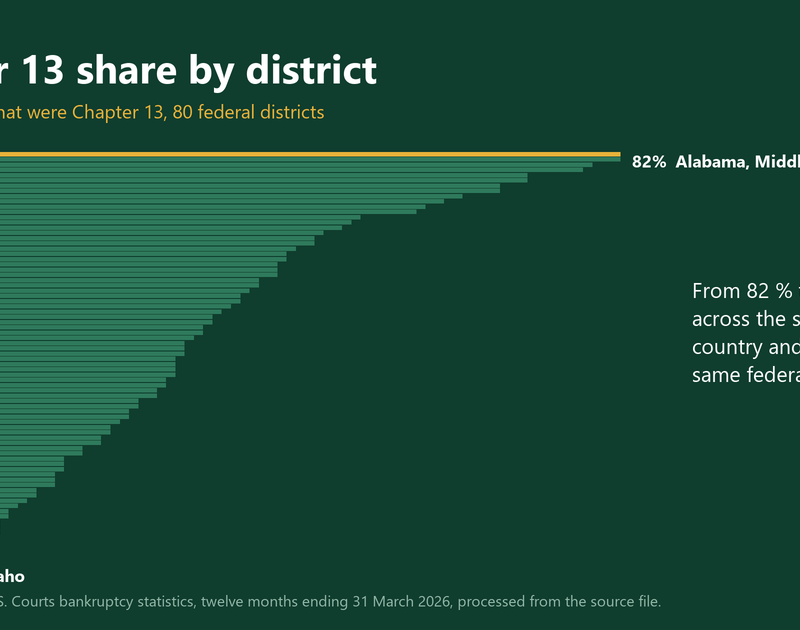
The second axis makes the point harder to argue with. Nevada files at 301.9 per hundred thousand and only 16.3% of its consumer filings are Chapter Thirteen. North Carolina files at 98.8 — roughly a third of Nevada’s rate — and 63.3% of its consumer filings are Chapter Thirteen. How often people file and which chapter they use are two independent things, and neither of them is a reading of the exemption schedule. We measured the chapter axis on its own in the Chapter Thirteen share by district.
So the route for your own case is the one at the top of this page and it does not change: read your state’s statute for the amounts, and use the five mechanisms below to understand what you are reading. Where the mechanism actually bites is on specific property — see how homestead equity is tested and how a financed vehicle is treated.
| State | Population (2024 estimate) | Filings in the year | Per 100,000 residents |
|---|---|---|---|
| Alabama | 5,157,699 | 21,688 | 420.5 |
| Mississippi | 2,943,045 | 10,368 | 352.3 |
| Tennessee | 7,227,750 | 22,800 | 315.5 |
| Nevada | 3,267,467 | 9,866 | 301.9 |
| Georgia | 11,180,878 | 33,570 | 300.2 |
| Kentucky | 4,588,372 | 12,689 | 276.5 |
| South Dakota | 924,669 | 746 | 80.7 |
| Massachusetts | 7,136,171 | 5,451 | 76.4 |
| New Hampshire | 1,409,032 | 1,064 | 75.5 |
| Vermont | 648,493 | 308 | 47.5 |
| Maine | 1,405,012 | 647 | 46.0 |
| Alaska | 740,133 | 306 | 41.3 |
How we built the rate, and why we did not rank states by generosity
The numerator is the court’s own count and the denominator is the Census Bureau’s own estimate. The only step we added is the division, done once for each of the fifty states and the District of Columbia, with every judicial district assigned to the state its filings are recorded under.
The obvious companion measurement is the one we did not make: an index of how much property each state protects. Doing that honestly would mean reading fifty-one statutes in their current text on the same day and pricing homestead, vehicle and wildcard on a comparable basis. We have not done it, and we are not going to approximate it from third-party summaries, because a confidently formatted table built out of stale summaries is exactly the artifact this page opens by warning you about. Until someone does that work, the ranking above is a description of where cases are filed and nothing more.
The table below puts the two axes side by side, because seeing them fail to line up is the fastest cure for the assumption that one explains the other. Alabama is at the top on both. Nevada is near the top on filings and near the bottom on Chapter Thirteen. Idaho and North Carolina are close to each other on filings and at opposite ends on chapter mix.
| Source | Administrative Office of the United States Courts, Table F-2, Bankruptcy Filings by District, with resident population from the U.S. Census Bureau’s Vintage 2024 state population estimates |
|---|---|
| What we asked it | For each state we summed the filings of every judicial district the F-2 records under it for the twelve months ended June 30, 2026, divided by that state’s POPESTIMATE2024 value from the Census file, and multiplied by 100,000. The chapter share is consumer Chapter 13 filings over consumer Chapter 7 plus Chapter 13 filings, from the nonbusiness columns of the same table. |
| Data as of | Filings for the twelve months ended June 30, 2026; population as estimated for July 1, 2024 |
| Retrieved | September 2, 2026 |
| Assumptions | The population estimate is for 2024 and the filings run to mid-2026, so the denominator is about two years older than the numerator; a judicial district is treated as belonging to one state, which is true for filing location but not for the debtor’s residence in every case; the fifty states plus the District of Columbia are ranked; Puerto Rico and the territories are in the underlying table but not in this ranking; no exemption amount enters the calculation at any point |
| How to repeat it | Download the F-2 workbook for the period from the court’s data tables page, group the district rows by state, then divide by the POPESTIMATE2024 column of the Census Bureau’s NST-EST2024-ALLDATA file and multiply by 100,000. |
| State | Filings per 100,000 residents | Chapter 13 share of consumer filings |
|---|---|---|
| Alabama | 420.5 | 69.8% |
| Mississippi | 352.3 | 53.7% |
| Nevada | 301.9 | 16.3% |
| Idaho | 129.1 | 8.1% |
| South Carolina | 103.0 | 65.0% |
| North Carolina | 98.8 | 63.3% |
What this does not say.
- This is a filing rate, not a hardship rate. A state where fewer people file is not a state where fewer people are insolvent; it may be a state where filing is more expensive, harder to reach, or less useful under local collection law.
- No exemption amount is measured anywhere in this calculation, so nothing here ranks states by how much property they protect. That is the whole reason the ranking is presented separately from the mechanisms and not as an explanation of them.
- The population estimate and the filing window do not cover the same period, which matters most for the fastest-growing and fastest-shrinking states.
- A judicial district is not always a state in substance. Delaware and the Southern District of New York attract corporate filings from across the country, which lifts their totals above what their residents alone would produce.
- Table F-2 counts cases opened. It records nothing about how they ended, what property was kept, or which exemption set the filer used, so no row here can be read as an outcome.
Frequently asked questions
What property can I keep in Chapter 7? Everything covered by your applicable exemptions — typically home equity up to the homestead limit, a vehicle up to the vehicle limit, retirement accounts, household goods, tools of your trade, and anything you can cover with a wildcard exemption. The amounts are set by statute and this page sends you to the statute rather than restating them.
Can I choose federal or state exemptions? In some states, yes; others have opted out and require the state set. Where a choice exists you must use one set in full and cannot combine the two, and your state’s own exemption statute usually says which regime applies in its opening lines.
What is a wildcard exemption? An amount that can be applied to any property, used to protect an asset that exceeds a category limit or does not fit a category at all. In several state sets it is larger if you are not claiming a homestead exemption, which creates a real trade-off between renters and homeowners.
Do exemptions double for married couples filing jointly? Many do, but not all, and homestead treatment for married filers differs by state. This is a specific point to confirm in your own statute rather than assume, because getting it wrong is expensive and the mistake surfaces only after the schedules are filed.
Which states have the most bankruptcy filings per person? In the twelve months to June 2026, Alabama at 420.5 filings per 100,000 residents, then Mississippi at 352.3, Tennessee at 315.5, Nevada at 301.9 and Georgia at 300.2. Alaska was lowest at 41.3. That ranking reflects local practice, collection law and cost as much as anything else, and it is not a measure of how generous each state’s exemptions are.
This article explains how bankruptcy exemptions work. No exemption amounts are stated here on purpose — federal figures are inflation-adjusted periodically and state amounts change. Get current figures from your state’s statute and confirm your Schedule C with a bankruptcy attorney. Not legal advice.
Sources
- 11 U.S.C. §522 — exemptions, including §522(b)(2) opt-out, §522(d) federal set, §522(b)(3)(A) residency rule, §522(p)
- U.S. Courts — Chapter 7 Bankruptcy Basics: exempt property under federal or home-state law
- Administrative Office of the U.S. Courts — Table F-2, Bankruptcy Filings by District, twelve months ended June 30, 2026 (accessed 2026-09-02)
- U.S. Census Bureau — Vintage 2024 state population estimates, file NST-EST2024-ALLDATA (column POPESTIMATE2024) (accessed 2026-09-02)
Information, not advice. How we calculate, source and review this — and what we do not do — is set out on our methods and sourcing page.