Yes, in most consumer cases — if two things are true: your equity is covered by your state’s homestead exemption, and you keep making the mortgage payments. The mortgage and the house are separate questions, and confusing them is what makes this topic feel more frightening than it usually is.
Question 1: how much equity is there?
Not what the house is worth. What is left after the debt against it.
Equity = fair market value − mortgage balance − any other liens (HELOC, tax lien, judgment lien).
A $400,000 house with a $360,000 mortgage has $40,000 of equity. A $400,000 house with a $410,000 mortgage has none — and a house with no equity is generally of no interest to a Chapter 7 trustee, because there is nothing to sell for the benefit of creditors after paying the mortgage and the costs of sale.
That is worth stating clearly because it covers a large share of the people asking this question: if you owe close to what the house is worth, the house is not what is at risk in your filing.
Question 2: is that equity exempt?
Every state has a homestead exemption protecting some amount of home equity from creditors, and the amounts vary enormously — a few states protect essentially the entire value, some protect very little, and several let you choose between state and federal exemption sets.
Two federal rules that catch people:
- A residency requirement. If you moved to your current state recently, you may be required to use your prior state’s exemptions rather than your new one. This exists specifically to stop people relocating to a generous state before filing.
- A cap on equity acquired shortly before filing, which limits the benefit of moving money into a homestead just before a case.
Get the figures from your state’s homestead exemption — they change, and an outdated number here would be worse than none.
If equity is fully exempt: the trustee cannot sell the house.
If equity exceeds the exemption: the trustee may sell it, pay the mortgage, pay you the exempt portion in cash, and distribute the rest to creditors. In practice trustees weigh the cost of sale, so a small excess may not be pursued — but that is a judgment call, not a rule, and it is not something to bet a house on without advice.
The third question, which matters more than people expect
Are you current on the mortgage?
A discharge eliminates your personal liability on the mortgage debt. It does not remove the lien. The lender can still foreclose if the loan is not paid — see why a discharge does not remove a lien.
So:
- Current, and equity is exempt: you keep the house and keep paying. Nothing changes about the mortgage.
- Behind on payments: filing Chapter 7 triggers the automatic stay, which stops a foreclosure sale immediately. But Chapter 7 provides no mechanism to catch up the arrears. After the discharge, the lender can resume where it left off.
That last case is the most important thing on this page, and it is the reason Chapter 13 exists. Chapter 13 puts the arrears into a three-to-five-year plan while you make current payments going forward. If you are four months behind and want to keep the house, Chapter 7 buys weeks and Chapter 13 fixes the problem. See why arrears push people to Chapter 13.
What you file about the house
On the Statement of Intention (Form B108) you declare what you intend to do with secured property: keep it and continue paying, surrender it, or redeem it. For a mortgage on a home you are keeping and current on, the practice in most districts is simply to keep paying — mortgage reaffirmation is treated differently from car loans, and requirements vary by district.
This is a place where local practice genuinely differs, which is one of the reasons this schedule is the one worth having reviewed if you are filing on your own. See why this is the schedule to get right.
Two things not to do before filing
Do not take equity out to pay unsecured debts. Converting protected equity into cash that pays credit cards right before a filing is examined as a preference or a transfer, and it can cost you the exemption and the discharge.
Do not transfer the house to a relative. This is the single most damaging pre-filing mistake people make on their own. A trustee can unwind transfers made before filing, and the transfer can support an objection to your discharge entirely.
The districts where four filings in five are the chapter that saves houses
The arrears paragraph above is the load-bearing one on this page: Chapter 7 stops a foreclosure sale and gives you no way to cure the payments behind it. That makes the chapter mix in your own court more relevant than it looks, because one chapter can fix an arrears problem and the other cannot, and the two are not used in anything like equal measure across the country.
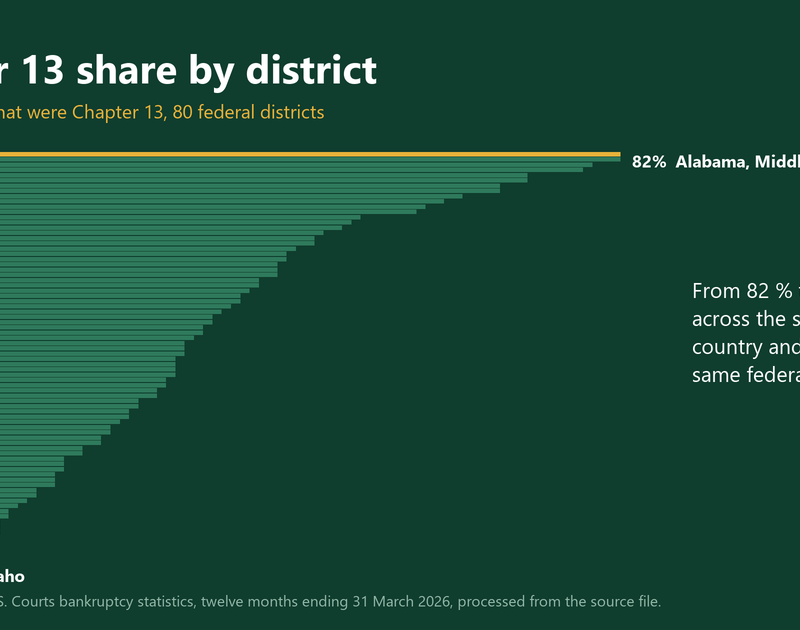
We took the consumer columns of Table F-2 for the twelve months ending in June 2026 and worked out, district by district, what share of consumer filings were the repayment chapter. Nationally it is 36.9%, across the 90 districts with enough consumer volume for the figure to be stable. In three districts, four out of every five consumer filings are the repayment chapter: the Middle District of Alabama at 82.1%, the Southern District of Georgia at 81.9% and the Western District of Louisiana at 80.2%. Five are above three quarters, the other two being the Southern District of Alabama at 77.9% and the Eastern District of North Carolina at 75.0%.
The concentration is regional rather than scattered. Of the twelve districts with the highest share, five sit in the Eleventh Circuit and three in the Fifth. Rolled up to states, Louisiana runs at 74.1% and Alabama at 69.8%, against a national figure barely over a third.
What that does not mean is that a filer in Alabama keeps a house a filer in Idaho loses. The outcome for your house turns on your equity, your homestead exemption and whether you are current, exactly as set out above, and none of those is in this data. What it does mean is that the chapter which can cure arrears is the ordinary local answer in some courts and an unusual request in others. If you are behind on the mortgage, that is worth knowing before you accept a first assessment as the only one available — see the Chapter Thirteen share by district, and what a plan costs before you assume it is the easy option.
| District | Circuit | Consumer Chapter 7 | Consumer Chapter 13 | Chapter 13 share |
|---|---|---|---|---|
| Middle District of Alabama | 11th | 1,186 | 5,446 | 82.1% |
| Southern District of Georgia | 11th | 725 | 3,289 | 81.9% |
| Western District of Louisiana | 5th | 1,168 | 4,733 | 80.2% |
| Southern District of Alabama | 11th | 932 | 3,285 | 77.9% |
| Eastern District of North Carolina | 4th | 1,358 | 4,077 | 75.0% |
| Eastern District of Louisiana | 5th | 784 | 2,286 | 74.5% |
| Western District of Tennessee | 6th | 2,416 | 6,522 | 73.0% |
| Middle District of Georgia | 11th | 2,111 | 4,674 | 68.9% |
| District of South Carolina | 4th | 1,832 | 3,638 | 66.5% |
| District of Puerto Rico | 1st | 2,100 | 3,807 | 64.4% |
| Northern District of Mississippi | 5th | 1,757 | 2,905 | 62.3% |
| Northern District of Alabama | 11th | 4,241 | 6,314 | 59.8% |
| National total | — | 366,863 | 214,153 | 36.9% |
How we counted the split, and why a high share is no promise about your house
One division per district, from the columns of Table F-2 that separate consumer cases from business ones, read out of the official workbook rather than the PDF. Districts with fewer than one hundred consumer filings in the year are left out, because there the percentage moves on a handful of cases and describes noise rather than practice.
Rolled up to state level the pattern holds, and the table below is the same measurement grouped by the state each district is recorded under. It is worth reading next to the filing volumes: Georgia and Tennessee are among the busiest states in the country and still run well above the national share, so this is not a small-state artifact.
The honest part is what the numbers refuse to say. A high repayment share is not a statement about homestead law, and we are not going to present it as one. Every state protects some amount of home equity, the amounts differ enormously, and Table F-2 measures none of them — it has no field for equity, for arrears, for a homestead claim, or for what happened to any property in any case. Read the mix as a description of local practice, and get the figures that actually decide your case from your own state’s homestead statute, linked further up this page.
| Source | Administrative Office of the United States Courts, Table F-2, Bankruptcy Filings by District, using the Predominant Nature of Debt: Nonbusiness columns |
|---|---|
| What we asked it | For each district we divided consumer Chapter 13 filings by the sum of consumer Chapter 7 and consumer Chapter 13 filings for the twelve months ended June 30, 2026, excluded districts with fewer than 100 consumer filings, ranked the remainder, and repeated the division on districts grouped by state and on the national nonbusiness totals. |
| Data as of | Twelve months ended June 30, 2026 |
| Retrieved | September 2, 2026 |
| Assumptions | Consumer Chapter 11 and Chapter 12 filings are excluded from the denominator, because the decision this page is about is between Chapter 7 and Chapter 13; districts with fewer than 100 consumer filings are dropped as noise, which removes three of the 93 districts from the ranking; a case is counted in the district where it was filed, with no attempt to reassign it to the debtor’s county or state of residence; the state rollup assigns each district to one state, which is accurate for filing location and not for the residence of every filer |
| How to repeat it | Download the F-2 workbook for the period from the court’s data tables page, take the nonbusiness Chapter 7 and Chapter 13 columns for each district, divide Chapter 13 by their sum, and sort. |
| State | Chapter 13 share of consumer filings | All filings in the year |
|---|---|---|
| Louisiana | 74.1% | 10,624 |
| Alabama | 69.8% | 21,688 |
| South Carolina | 65.0% | 5,642 |
| North Carolina | 63.3% | 10,915 |
| Tennessee | 56.1% | 22,800 |
| Georgia | 53.2% | 33,570 |
What this does not say.
- A chapter mix is not an outcome. Nothing on this page says a house was kept or lost in any of these cases; Table F-2 records the chapter and has no field for property, equity, arrears or discharge.
- The table does not explain itself. Local fee practice, trustee and judicial practice, state foreclosure timelines and the homestead exemption are all candidate explanations, and not one of them is measured here.
- Three districts are excluded for low consumer volume, so the ranking describes 90 of the 93 districts.
- The share counts filings in a year, not households in arrears. A district can run a high repayment share for reasons that have nothing to do with how many of its residents are behind on a mortgage.
- Business filings are excluded from the share on purpose, so these percentages are not comparable with the all-filings chapter shares used elsewhere on this site.
Frequently asked questions
Will I lose my house if I file bankruptcy? Usually not. You keep it if your equity is within your state’s homestead exemption and you stay current on the mortgage. The risk concentrates in two situations: substantial non-exempt equity, or arrears that Chapter 7 has no mechanism to cure.
Do I have to sell my house in Chapter 7? You do not sell it. A trustee could, but only if there is non-exempt equity worth pursuing after the mortgage and the costs of sale. With little or no equity the house is not an asset the estate can realize, which covers a large share of the people asking this.
What happens to my mortgage in Chapter 7? Your personal liability for the debt is discharged and the lien survives. In practical terms: keep paying and keep the house, or stop paying and the lender forecloses without being able to pursue you for a deficiency. The discharge and the lien are separate things.
Can Chapter 7 stop a foreclosure? It stops a scheduled sale immediately through the automatic stay, but it does not cure the arrears, so the foreclosure can resume after the case unless the loan is brought current or modified. Chapter 13 is the chapter that provides a way to catch up — and it is 36.9% of consumer filings nationally, rising above 80% in three districts.
What if I have a second mortgage or HELOC? Both are liens and both count against your equity, which often means there is no non-exempt equity at all. Liens survive Chapter 7. Stripping a wholly unsecured junior lien is a Chapter 13 tool rather than a Chapter 7 one.
This article explains how a home is treated in Chapter 7 in general terms. It is not legal advice. Homestead exemptions are state law, they change, and equity and lien facts are case-specific — the outcome for your house depends on details this article cannot know. Speak to a bankruptcy attorney in your district before filing if you own real estate.
Sources
- U.S. Courts — Chapter 7 Bankruptcy Basics: exempt property and the trustee’s sale of nonexempt assets
- 11 U.S.C. §522 — exemptions; §522(o) and (p) residency and equity caps
- 11 U.S.C. §362 — automatic stay
- Administrative Office of the U.S. Courts — Table F-2, Bankruptcy Filings by District, twelve months ended June 30, 2026 (accessed 2026-09-02)
- Table F-2 workbook (XLSX) for the twelve months ended June 30, 2026 — the nonbusiness Chapter 7 and Chapter 13 columns used here (accessed 2026-09-02)
Information, not advice. How we calculate, source and review this — and what we do not do — is set out on our methods and sourcing page.