If you are current on the loan and your equity is exempt, you keep the car. How you keep it depends on three options the Bankruptcy Code gives you — reaffirm, redeem, or surrender — and you declare your choice on Form B108 shortly after filing.
The one that carries a hidden cost is the one most people choose by default.
First: is there equity, and is it exempt?
Same arithmetic as a house. Equity = value − loan balance.
Most financed cars have little or negative equity, especially in the first few years, which means the car is not an asset a trustee can realize. Owing more than the car is worth takes the trustee out of the picture entirely; what is left is only which of the three options below costs you least, and negative equity is the strongest argument against reaffirming and the strongest argument for surrender.
If there is equity — a nearly paid-off car, or a paid-off one — your state’s motor vehicle exemption protects some amount of it. Amounts vary widely by state, and several states allow a “wildcard” exemption that can be stacked on top to cover the excess. Check your state’s motor vehicle exemption.
The paid-off car case, which appears in the search data as its own question: you keep it if its full value fits within your vehicle exemption plus any available wildcard. If it is worth substantially more than that, the trustee could sell it, pay you the exempt amount in cash, and distribute the rest. In practice this is why the family car is usually safe and the low-mileage third vehicle is not.
Option 1: Reaffirm — keep the car, keep the loan
A reaffirmation agreement is a new contract with the lender in which you agree that the car debt survives your bankruptcy. You keep the car, keep the payments, and the loan continues as if you had not filed. The court reviews the agreement, and can decline to approve one that appears to impose an undue hardship.
This is what most filers do, and here is the part that is rarely said out loud: reaffirming reinstates your personal liability for a debt that was about to be discharged. If the car is repossessed two years later, you can be pursued for the deficiency balance — the very thing bankruptcy would have eliminated.
That trade is worth making when you need the car and the loan terms are reasonable. It is a bad trade when the loan is at a punitive rate on a depreciating vehicle you owe far more on than it is worth. Do not sign a reaffirmation for a car you are not sure you will keep.
Some districts allow a “ride-through” — continuing to pay without reaffirming — and the treatment varies by district and circuit. It is not a universal right and it is a question for local counsel.
Option 2: Redeem — buy it out at what it is worth
Redemption lets you keep the car by paying the lender its current value in a lump sum, rather than the loan balance. Owe $14,000 on a car worth $8,000, pay $8,000, and the rest of the debt is discharged.
It is the most favorable option arithmetically and the least used, because it requires a lump sum. A small market of redemption lenders exists specifically for this, generally at high rates — which can still be worth it when the gap between balance and value is large.
Option 3: Surrender — hand it back
You return the car and the entire debt, including any deficiency after the lender sells it, is discharged.
This is the right answer more often than people think: a car worth $8,000 with a $19,000 balance at 21% is frequently the largest single drag on a household budget, and bankruptcy is the one moment when walking away costs nothing beyond the loss of the vehicle. Filers routinely surrender and then buy a cheap replacement outright — and, uncomfortably but truly, car lenders will lend to a recent Chapter 7 filer, because the discharged debt means more available income and no ability to file again for years.
Deadlines, which are short
You state your intention on Form B108 and must act on it within a short statutory window. Missing the deadline can allow the automatic stay to terminate as to the vehicle, letting the lender repossess. This is one of the more common ways a self-filed case loses a car that could have been kept.
What Chapter 13 does differently
Chapter 13 offers tools Chapter 7 does not:
- Curing arrears on the loan inside the plan while making current payments.
- A cramdown in some cases — reducing the secured portion of the loan to the car’s actual value, with the rest treated as unsecured, subject to a rule about how long ago the car was purchased.
If you are behind on the car and want to keep it, that difference decides the chapter. See how Chapter 13 handles a car differently.
Why the same car survives in one district and not the next
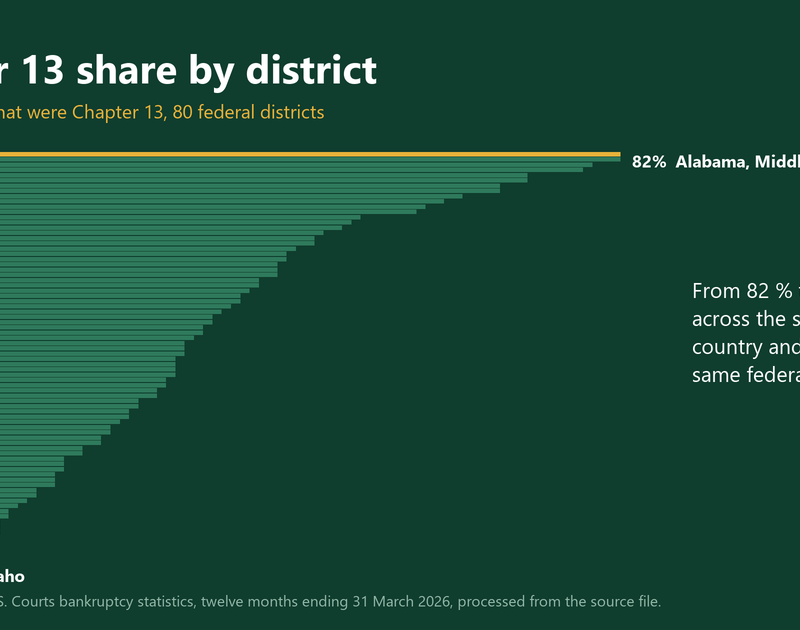
Whether you keep the car turns on your state’s vehicle exemption and on which of the three options above you choose. What is rarely said is that both of those sit inside a third variable, and it is the court you file in. Table F-2 from the Administrative Office of the U.S. Courts records every consumer filing by chapter and by district, and the mix is nowhere near uniform. Nationally, 36.9% of consumer filings are the repayment chapter rather than Chapter 7, measured across the 90 districts with enough consumer volume for the share to mean anything.
In the Middle District of Alabama it is 82.1%. In Idaho it is 8.1%. That is a spread of 10.1 to one between two courts applying the same federal code to the same kinds of household.
This matters for a car more than for almost any other asset, because the two chapters keep a vehicle by completely different machinery. Chapter 7 keeps it through the exemption: if the equity fits inside it the trustee has no interest, and the remaining decision is reaffirm, redeem or surrender. Chapter Thirteen keeps it through the plan: arrears are cured over three to five years while you pay currently, and in some cases the secured part of the loan is written down to what the vehicle is actually worth. In the Western District of Tennessee, where 73.0% of consumer filings are Chapter Thirteen, the plan route is what the local bar does all day. In Idaho it is the exception.
None of that changes the law that applies to you, and none of it predicts your case. What it changes is what the practitioners, trustees and judges around you are fluent in, which is a real thing to know before you treat a first opinion as the only available answer. We measured the split on its own in the Chapter Thirteen share by district.
| District | Consumer Chapter 7 | Consumer Chapter 13 | Chapter 13 share |
|---|---|---|---|
| Middle District of Alabama | 1,186 | 5,446 | 82.1% |
| Southern District of Georgia | 725 | 3,289 | 81.9% |
| Western District of Louisiana | 1,168 | 4,733 | 80.2% |
| Southern District of Alabama | 932 | 3,285 | 77.9% |
| Eastern District of North Carolina | 1,358 | 4,077 | 75.0% |
| Eastern District of Louisiana | 784 | 2,286 | 74.5% |
| Southern District of California | 4,700 | 738 | 13.6% |
| District of New Mexico | 1,433 | 212 | 12.9% |
| District of North Dakota | 705 | 103 | 12.7% |
| Northern District of Oklahoma | 1,805 | 237 | 11.6% |
| Eastern District of Oklahoma | 1,125 | 143 | 11.3% |
| District of Idaho | 2,282 | 201 | 8.1% |
| National total | 366,863 | 214,153 | 36.9% |
What the split does not explain, and what the plan route costs
The table records the mix. It does not record why the mix is what it is, and that gap is better stated than filled. The plausible causes are all local: what the local bar charges for each chapter and how that fee can be paid, how trustees and judges handle particular kinds of collateral, how fast repossession moves under state law, and the exemption schedule itself. Table F-2 has a column for none of them, so anyone who tells you a district is a Chapter Thirteen district because of its exemptions is adding a claim to the data rather than reading one out of it.
The other thing the mix does not tell you is what the plan route costs, and it is not free. Curing arrears on a vehicle inside a plan means committing to years of payments, and the plan is a single instrument covering all your debt rather than a payment arrangement on the car. If that is the option in front of you, the two things worth reading before agreeing to it are what a plan actually costs and what happens if a plan cannot be completed.
Read together with the arithmetic at the top of this page, the practical order does not change. Work out the equity first, because negative equity takes the trustee out of the picture in either chapter and makes surrender the cheapest option available. Then look at what your district does, because that is what decides whether the plan route is a routine local answer or an unusual request.
How we measured the district split, and the five things it cannot tell you
The measurement is one division per district, from the columns of Table F-2 that separate consumer cases from business ones. We used the official workbook rather than the PDF, and we left out districts with fewer than one hundred consumer filings, because in a district that small the percentage swings on a handful of cases and tells you about noise rather than practice.
The counts are the court’s. The shares, the national figure and the ratio between the extremes are ours, and they can be rebuilt from a single downloaded sheet.
| Source | Administrative Office of the United States Courts, Table F-2, Bankruptcy Filings by District, using the Predominant Nature of Debt: Nonbusiness columns |
|---|---|
| What we asked it | For each district we divided consumer Chapter 13 filings by the sum of consumer Chapter 7 and consumer Chapter 13 filings for the twelve months ended June 30, 2026, then excluded districts with fewer than 100 consumer filings and computed the same ratio on the national nonbusiness totals. |
| Data as of | Twelve months ended June 30, 2026 |
| Retrieved | September 2, 2026 |
| Assumptions | Consumer Chapter 11 and Chapter 12 filings are left out of the denominator, because the choice this page is about is between Chapter 7 and Chapter 13; districts with fewer than 100 consumer filings in the year are excluded as noise, which drops three of the 93 districts from the ranking; a district is used as filed, with no attempt to reassign cases to the debtor’s county or state of residence |
| How to repeat it | Download the F-2 workbook for the period from the court’s data tables page, take the nonbusiness Chapter 7 and Chapter 13 columns for each district, and divide Chapter 13 by their sum. |
What this does not say.
- The share is a mix of filings, not an outcome. Nothing here says a car was kept, redeemed or surrendered in any of these cases: Table F-2 records the chapter and has no field for property at all.
- The table does not say why a district’s mix is what it is. Local fee practice, trustee and judicial practice, state collection law and the exemption schedule are all candidates and none of them is measured here.
- Three districts are excluded for low consumer volume, so the spread describes 90 of the 93 districts rather than all of them.
- Where you file follows where you live rather than being chosen. This spread is useful for understanding what is normal around you; it is not a menu, and moving to a district with a different mix is not a strategy.
- Business filings are excluded from these shares on purpose, which means these percentages are not comparable with the all-filings chapter shares published elsewhere on this site.
Frequently asked questions
Do I have to reaffirm my car loan in Chapter 7? Not necessarily. Reaffirmation is one of three declared options and whether you can simply keep paying without reaffirming depends on your district. What you cannot do is ignore the statement of intention and its deadline, which is one of the more common ways a self-filed case loses a car that could have been kept.
What happens if I do not reaffirm? Depending on the district, the lender may repossess even while you are current, or may let payments continue without a reaffirmation. Your personal liability for the debt is discharged either way, which is exactly why not reaffirming is sometimes the deliberate choice rather than an oversight.
Can I keep my car if I am behind on payments? In Chapter 7, only by bringing the loan current or negotiating with the lender: the filing pauses repossession but provides no mechanism to cure the default. Chapter 13 does provide one, which is why the arrears case is the case that decides the chapter, and why the local mix of chapters is worth knowing.
Can I keep two cars in Chapter 7? Possibly, depending on your exemptions and whether both are needed. Combined equity across both vehicles has to fit within the exemptions available to you, and a second vehicle with real equity is a common target because the wildcard usually cannot stretch that far.
This article explains how vehicles are treated in Chapter 7 in general terms. It is not legal advice. Exemption amounts are state law, reaffirmation practice varies by district, and the deadlines are strict. Confirm your options with a bankruptcy attorney in your district before filing.
Sources
- U.S. Courts — Chapter 7 Bankruptcy Basics
- 11 U.S.C. §521 — Debtor’s duties: subsection (a)(2) on the statement of intention and the deadlines for acting on it
- U.S. Courts — Form B 108, Statement of Intention for Individuals Filing Under Chapter 7
- Administrative Office of the U.S. Courts — Table F-2, Bankruptcy Filings by District, twelve months ended June 30, 2026 (accessed 2026-09-02)
- Table F-2 workbook (XLSX) for the twelve months ended June 30, 2026 — the nonbusiness Chapter 7 and Chapter 13 columns used here (accessed 2026-09-02)
Information, not advice. How we calculate, source and review this — and what we do not do — is set out on our methods and sourcing page.