Everything below comes from the federal courts’ own summary of chapter 13 and from the statute sections that summary cites. The source is Chapter 13 Bankruptcy Basics, published by the United States Courts and consulted on 21 August 2026. Quoted wording belongs to the source or to the statute. The section numbers are printed so the reading can be checked instead of trusted.
The question here is narrow. The plan is in place, the payments have become impossible, and something is going to happen. What almost no consumer guide lays out is that the available responses have an order, and the order is set by the statute rather than by preference. Modification comes first. A hardship discharge is not a parallel option to it: it is what becomes reachable once modification genuinely is not. How the two chapters differ in the first place: Chapter 7 vs Chapter 13.
What this page is, and what no page can do
A summary published by the courts is a dependable description of the framework. It is not a decision about anyone’s case, and neither is this article. Whether a particular set of facts amounts to “circumstances beyond the debtor’s control” is decided case by case, by a judge, on the record actually in front of that judge. That judgment cannot be made from a web page, and this one does not attempt it.
Nothing here is legal advice. This site publishes research about debt; it does not practice law and it represents nobody. Anyone whose plan is failing is in the situation where a description of the framework has already done all it can, and a bankruptcy attorney or the case trustee is the next step.
What section 1307(c) puts on the table when payments stop
If the debtor fails to make the payments the plan requires, the courts’ summary states the consequence in the words of 11 U.S.C. § 1307(c): “the court may dismiss the case or convert it to a liquidation case under chapter 7 of the Bankruptcy Code.” What that conversion would and would not wipe out: what bankruptcy clears, and what filing Chapter 7 costs.
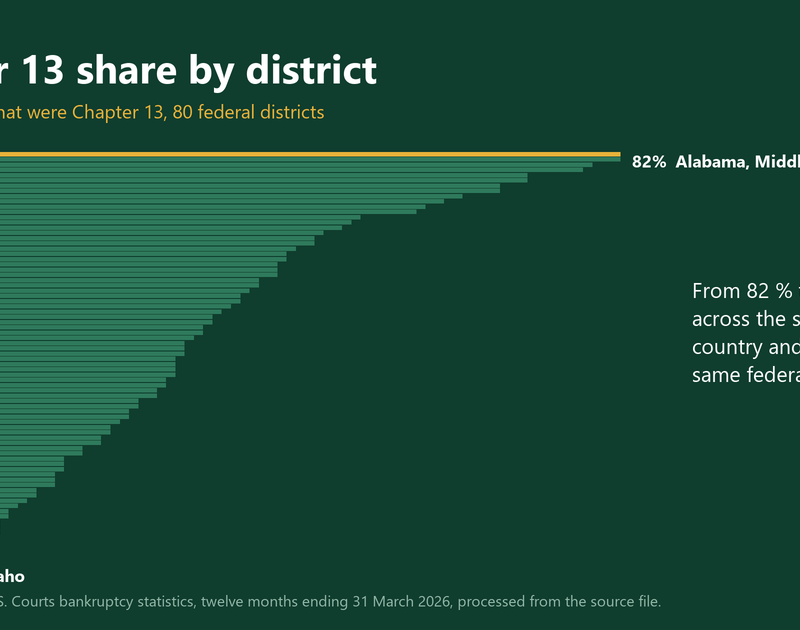
Two things are worth pulling out of that sentence. The first is that there are two outcomes named, not one, and dismissal and conversion are not the same event. The second is the word “may.” The provision is written permissively; it describes what the court is empowered to do, not an automatic result that follows from a missed payment. How often each chapter is filed varies sharply by court: Chapter 13 share by district.
What each of those two outcomes then means, in practical terms, for property and for creditors is a longer subject than the passage I read covers, and it is not going to be filled in here from memory.
Two triggers that have nothing to do with plan payments
The same provision reaches beyond the payments. Under § 1307(c) the court may also dismiss the case or convert it for:
- failure to pay post-filing domestic support obligations; and
- failure to make required tax filings.
This is the failure mode people do not see coming. The monthly plan payment can be current and on time, and the case can still be exposed, because two of the grounds sit outside the plan entirely. One of them is not even a payment: it is a filing. A return that never went in is a ground the statute names alongside missed support payments.
Modification comes first
11 U.S.C. §§ 1323 and 1329 allow a plan to be modified either before or after confirmation. That is the sentence to hold on to, because “after confirmation” is the half most people assume is closed. Confirmation is not the moment at which the numbers become permanent.
The reason this section sits above the hardship discharge rather than below it is structural, and it comes straight out of § 1328(b), quoted further down: “modification of the plan is not possible” is one of the three conditions for a hardship discharge. The statute has sequenced the two routes itself. Modification is not the softer alternative to be tried if the debtor feels like it; the harder route is defined partly by modification being unavailable.
What the summary I read does not do is say what a modification can change, on what showing, or by what standard a court decides. Those questions belong with someone who can see the docket and the schedules.
The five-year ceiling on any plan
Modification is not unlimited, and the limit is stated without qualification. 11 U.S.C. § 1322(d): “In no case may a plan provide for payments over a period longer than five years.”
Set that against the section above. Spreading the payments over more time is the most obvious way to make an unaffordable plan affordable again, and the statute puts a hard ceiling on how far that can be spread. The ceiling is written as an absolute, and it applies to what a plan may provide for, which is why “just stretch it out” is a route with a fixed end rather than an open one.
The hardship discharge, and its three conditions
11 U.S.C. § 1328(b) is the provision that allows a discharge without the plan having been completed. The courts’ summary sets out three conditions, and all three have to be met:
- the debtor’s failure to complete the payments is due to “circumstances beyond the debtor’s control and through no fault of the debtor”;
- creditors have received at least what they would have received in a chapter 7 liquidation; and
- “modification of the plan is not possible.”
The first condition is a finding a judge has to make, and it is doubled: beyond the debtor’s control and through no fault of the debtor. The second is a comparison against a hypothetical, which is to say against what a chapter 7 liquidation would have produced for those creditors. The third is the link back to the previous section.
Why the two routes are linked rather than parallel
Read the third condition again and the architecture shows. A debtor cannot choose the hardship discharge over a modification, because the impossibility of modifying is part of what has to be established to get the hardship discharge at all. The two are not options on a menu. They are steps, and the second one is defined by the first having been ruled out.
The practical consequence of that ordering is a question of sequence rather than of preference, and it is the reason this article is arranged the way it is. What counts as impossible, and who has to show it, is decided in the case and not on this page.
What a hardship discharge leaves standing
Now the trade. The courts’ summary describes the hardship discharge as “more limited” than the discharge available on completion of a plan, and it names the limit exactly: it “does not apply to any debts that are nondischargeable in a chapter 7 case.”
The examples the source gives of debts that are not discharged:
- nondischargeable taxes;
- alimony;
- child support;
- certain student loans; and
- debts arising from willful or malicious injury.
“Certain student loans” is the source’s own hedge, and it is left as a hedge here rather than sharpened into a rule it does not state.
Stated flatly, the trade is this. A hardship discharge can arrive without the plan being finished, which is precisely what a debtor in trouble wants. It is also worth less than the discharge at the end of a completed plan, because everything a chapter 7 case would have left standing is still standing afterwards. Earlier, and smaller.
What completing the plan requires instead
For contrast, the ordinary route. Under 11 U.S.C. § 1328, the discharge comes upon completion of all payments under the plan, provided that the debtor:
- certifies that domestic support obligations are paid;
- has not received a recent prior discharge; and
- “has completed an approved course in financial management.”
The third item is administrative and it is the kind of requirement that gets overlooked precisely because it is not about money. It is written into the same section as the discharge itself.
| Discharge on a completed plan | Hardship discharge | |
|---|---|---|
| Statute | 11 U.S.C. § 1328 | 11 U.S.C. § 1328(b) |
| When it is reachable | Upon completion of all payments under the plan | Without the payments having been completed, if all three conditions are met |
| What the source names as required | Certification that domestic support obligations are paid; no recent prior discharge; an approved course in financial management completed | Failure to complete due to circumstances beyond the debtor’s control and through no fault of the debtor; creditors received at least the chapter 7 equivalent; modification of the plan is not possible |
| Reach | The summary describes the hardship version as more limited than this one | “More limited”; does not apply to any debts that are nondischargeable in a chapter 7 case |
Where this article stops
Four boundaries, so that none of the above is read as more than it is.
- One summary and its citations. The courts’ overview of chapter 13 was read, along with the sections it cites. No case law was read, and no local rule of any bankruptcy court was read.
- The hard words are decided by a judge. “Circumstances beyond the debtor’s control,” “through no fault of the debtor,” and “modification of the plan is not possible” are all determinations made on a record. Nobody can tell a debtor in advance how a court will find on them.
- No numbers appear here. The source carries none for these provisions, so none have been supplied, including for anything a filing or a modification might involve.
- Not a lawyer, not a law firm. This is a description of a framework published by the courts. The trustee assigned to a case and an attorney admitted in that district are the people who can act on it.
What survives all that is a short and genuinely useful shape. Missing payments opens two doors under § 1307(c), dismissal and conversion, and support obligations and tax filings can open them even when the plan payments are current. Modification under §§ 1323 and 1329 is available before or after confirmation, and it is bounded by the five-year ceiling in § 1322(d). Only when modification is not possible does § 1328(b) come into view, and what it delivers leaves every chapter 7 nondischargeable debt exactly where it was.
How many plans start each year, and where they start
The boundary set out above still holds: the statute carries no numbers for any of these provisions, and none have been invented for them. What the federal courts do publish is the denominator — how many plans begin. In the twelve months ending June 30, 2026, 215,490 Chapter 13 cases were commenced across the country, 214,153 of them by consumers rather than businesses. A year earlier the consumer figure was 198,971.
Those are cases opened, which is a different event from the one this page is about. But the size of the denominator is worth stating plainly, because the impossible plan payment is not a rare situation happening to a handful of people. Something over two hundred thousand consumer cases a year begin a three-to-five year commitment, and the number is going up rather than down.
Read the chart as a level and not as a trend in quarters. Each point is a rolling twelve-month total, which is how the courts publish this table, so the middle point overlaps both of the others and none of the three is an independent observation.
| 12 months ending | Consumer Chapter 13 cases | Consumer Chapter 7 cases | All Chapter 13 cases | Plan share of consumer cases |
|---|---|---|---|---|
| June 30, 2025 | 198,971 | 320,007 | 200,290 | 38.3% |
| March 31, 2026 | 210,345 | 354,989 | 211,700 | 37.2% |
| June 30, 2026 | 214,153 | 366,863 | 215,490 | 36.9% |
Plan starts are rising, and three large districts are moving the other way
Plan starts are also rising unevenly, and the spread is wide enough that a district’s own direction can be the opposite of the national one. Florida’s Middle District started 6,108 consumer plans in the year to June 2026 against 4,847 the year before. Ohio’s Northern District went the other way, to 2,628 from 2,904, and Illinois’ Central District to 689 from 818.
Why that matters to somebody whose payment has become impossible: the trustee’s office handling your case is handling a caseload, and modification under § 1323 and § 1329 is a motion that has to be prepared, filed and heard. A district taking on a quarter more plans than it did a year ago is not a district with more time. Nothing in the statute changes; the queue does.
It also matters for reading advice you find locally. In a district where a plan is the usual filing, the local bar has seen this exact situation many times over; in a district where plans are unusual, it has not. And if it is the arithmetic of the plan that became impossible rather than your income, what the plan bills while it runs is set out in the cost of a Chapter 13 plan, line by line.
| District | Plans started, year to June 2026 | Year to June 2025 | Change | Plan share of consumer cases |
|---|---|---|---|---|
| Florida, Middle | 6,108 | 4,847 | +26.0% | 21.8% |
| Washington, Western | 1,701 | 1,385 | +22.8% | 22.9% |
| Nevada | 1,594 | 1,360 | +17.2% | 16.8% |
| North Carolina, Western | 1,441 | 1,236 | +16.6% | 53.6% |
| North Carolina, Middle | 1,217 | 1,045 | +16.5% | 53.1% |
| California, Southern | 738 | 637 | +15.9% | 13.6% |
| Louisiana, Eastern | 2,286 | 1,977 | +15.6% | 74.5% |
| Michigan, Western | 1,327 | 1,151 | +15.3% | 32.4% |
| South Carolina | 3,638 | 3,162 | +15.1% | 66.5% |
| Hawaii | 424 | 459 | -7.6% | 37.3% |
| Ohio, Northern | 2,628 | 2,904 | -9.5% | 17.9% |
| Illinois, Central | 689 | 818 | -15.8% | 24.5% |
The completion rate is the number you want, and this table does not have it
Now the number that would actually answer the question, and why it is not here. Nobody reading this page wants to know how many plans start. They want to know how many finish. Table F-2 counts cases commenced. It carries no column for confirmation, none for completion, none for dismissal and none for conversion, at national level or by district. There is no release in this series from which a completion rate can be computed.
So we are not going to give you one. The figures that circulate for how often Chapter 13 plans fail come from academic studies of samples of court records, not from this table, and attaching one of them to the counts above would be presenting a borrowed estimate as a measurement. What the counts above can honestly support is the scale of the population, and the direction it is moving in. Not your odds.
That is also why the order of the responses in this article is the useful part rather than a statistic. The statute is the same in every district and it puts modification before the hardship discharge everywhere. The queue in front of it is what varies, and the reason to move early is that the queue is getting longer.
How the three releases were read and checked
The check we run before publishing any figure from this table: the courts print a Total row, and we never read it as an input. We sum the 93 district rows ourselves and compare the two. They agree exactly in all three releases used here, chapter column by chapter column. A parse that drops a district row or reads one twice produces a table that still looks reasonable, and that comparison is the only thing that catches it. How we source and check figures across this site is set out on our methods page.
The consumer counts are the table’s own nonbusiness columns. The district comparison matches releases by the court’s own district code rather than by row position, because the earlier release carries one row fewer, and it is restricted to districts that started at least three hundred plans in the earlier year, so that a change is not being computed on a base small enough to move on a handful of cases.
| Source | Administrative Office of the United States Courts, Table F-2, U.S. Bankruptcy Courts Business and Nonbusiness Cases Commenced by Chapter of the Bankruptcy Code |
|---|---|
| What we asked it | We read the official XLSX releases for the 12-month periods ending June 30, 2026, March 31, 2026 and June 30, 2025, district row by district row, summed the district rows and compared each sum with the Total row the courts print on that release before computing anything from it |
| Data as of | 12-month periods ending June 30, 2025, March 31, 2026 and June 30, 2026 |
| Retrieved | September 2, 2026 |
| Assumptions | Each release is a rolling twelve-month total, so the three windows overlap and are read as levels rather than as three independent periods; consumer counts are the table’s own nonbusiness columns, not an estimate of ours; the district comparison matches releases by district code and is limited to districts that started at least three hundred consumer plans in the earlier year |
| How to repeat it | Download the F-2 workbooks for the periods ending June 30, 2026 and June 30, 2025 from the courts’ data-tables pages, take the nonbusiness Chapter 13 column, sum the district rows, check each sum against the printed Total row, and then compare the two releases code by code |
What this does not say.
- There is no completion rate here and none can be derived from this source. Table F-2 counts cases commenced and carries no column for confirmation, completion, dismissal or conversion, so nothing above says anything about how often a plan is finished.
- Cases commenced is not households. A joint case is one case, and a person who files, is dismissed and files again appears more than once, so the counts are of court cases and not of people.
- The three windows overlap. Each release is a rolling twelve-month total, so the middle one shares nine months with each of the others and the three points are not independent observations of anything.
- The inference from a growing docket to a busier trustee’s office is ours, not the courts’. The release reports filings, not staffing, caseload per trustee or time to hearing, and none of those was measured.
- None of this is about your case. Whether modification is possible, and whether the hardship conditions are met, are determinations a judge makes on a record, and no national count has any bearing on either.
Frequently asked questions
What happens if I cannot afford my Chapter 13 plan payment? Under section 1307(c) the court may dismiss the case or convert it to Chapter 7 for failure to make payments. Before either, modification under sections 1323 and 1329 is the first route, and it is available before or after confirmation. Acting early is the whole game, because the alternatives narrow once payments have already been missed.
Can my Chapter 13 plan be modified after confirmation? Yes. Section 1329 allows a confirmed plan to be modified on request, including to change the amount of payments. The five-year ceiling in section 1322(d) still applies, so a modification cannot simply stretch the plan indefinitely to make the arithmetic work.
What is a hardship discharge in Chapter 13? It is the discharge available under section 1328(b) when a plan cannot be completed. Three conditions have to be established: the failure is due to circumstances for which the debtor should not justly be held accountable, unsecured creditors have already received at least what Chapter 7 would have paid them, and modification of the plan is not possible.
Can I ask for a hardship discharge instead of modifying my plan? The two are not parallel options. The impossibility of modifying is part of what has to be established to get the hardship discharge at all, because modification not being possible is one of the three conditions in section 1328(b). They are steps, not items on a menu, and the second is defined by the first having been ruled out.
What does a hardship discharge not cover? It is more limited than the discharge available on completion, and it does not apply to any debt that would be nondischargeable in a Chapter 7 case. The examples the courts’ own summary gives are nondischargeable taxes, alimony, child support, certain student loans, and debts arising from willful or malicious injury.
Can my case be dismissed even if my plan payments are current? Yes. Under section 1307(c) the court may also dismiss or convert the case for failure to pay post-filing domestic support obligations or to make required tax filings. Two of the grounds sit outside the plan payments entirely, and one of them is a filing rather than a payment.
How many people are in a Chapter 13 plan? The federal courts do not publish a stock of active plans, only cases commenced. In the twelve months to June 2026, 214,153 consumer Chapter 13 cases were opened, up from 198,971 the year before. Since plans run three or five years, the number of households currently paying into one is larger than any single year’s figure.
What share of Chapter 13 plans are completed? We cannot tell you from this source and we are not going to borrow a figure for it. Table F-2 counts cases commenced and carries no confirmation, completion, dismissal or conversion column at all, so no completion rate can be computed from the federal filing statistics.
Sources
- Administrative Office of the U.S. Courts — Table F-2, bankruptcy filings by district and chapter, 12-month period ending June 30, 2026 (accessed 2026-09-02)
- Administrative Office of the U.S. Courts — Table F-2, 12-month period ending June 30, 2025, used as the year-earlier comparison (accessed 2026-09-02)
- Administrative Office of the U.S. Courts — Table F-2 workbook (XLSX) for the period ending June 30, 2026 (accessed 2026-09-02)
Information, not advice. How we calculate, source and review this — and what we do not do — is set out on our methods and sourcing page.