Correction, 20 August 2026. This page had Official Forms 103A and 103B the wrong way round. Read at source that day: Form 103A is the Application for Individuals to Pay the Filing Fee in Installments, and Form 103B is the Application to Have the Chapter 7 Filing Fee Waived. Asking a clerk for the wrong one of those two costs you time you may not have, so the swap mattered.
The court filing fee is $338, the two required courses run roughly $20–$100 total, and an attorney commonly charges somewhere in the range of $1,000–$2,500 for a straightforward consumer case. So a represented filing is typically in the low four figures, and a self-filed one is a few hundred dollars.
And it can be free. That part is on Form B103B and it is left out of most coverage.
The line items
| Item | Cost | Notes |
|---|---|---|
| Court filing fee | $338 | Verify the current figure — it changes by judicial order |
| Credit counseling course (before filing) | ~$10–$50 | Must be a DOJ-approved provider; often waivable |
| Debtor education course (after filing) | ~$10–$50 | Also from an approved provider |
| Attorney fees | commonly $1,000–$2,500 | Varies widely by district and case complexity |
| Credit reports | free | annualcreditreport.com |
Chapter 13’s court fee is lower ($313), and its attorney fees are substantially higher because the case runs for years — often paid through the plan rather than up front. The full breakdown, including the district-published fee a court will approve without an itemised application: what Chapter 13 actually costs.
The fee waiver almost nobody mentions
Form B103B waives the filing fee entirely. To qualify, generally: household income below a threshold tied to the federal poverty guidelines for your household size, and an inability to pay even in installments.
This is the direct answer to a question a lot of people are searching — how to file bankruptcy with no money — and it is a routine application, not an exotic one. Form B103A is the fallback: paying the fee in installments, typically up to four payments.
The two courses can also usually be provided at reduced cost or free by approved providers on a sliding scale. Ask the provider directly; it is not always advertised.
The trap: Chapter 7 attorney fees are paid before filing
This is the structural problem in consumer bankruptcy and it deserves stating plainly.
An attorney generally cannot be paid from the estate after a Chapter 7 filing, so the fee is collected up front. Which means the people least able to assemble $1,500 in cash are the ones who need the discharge most — and the common consequence is that they end up in Chapter 13, where fees are paid over the life of the plan, even when Chapter 7 was the better chapter for them.
Three real ways around it:
- Legal aid. Many organizations handle consumer bankruptcy for qualifying incomes at no charge. This is the first call, not the last.
- Law school clinics. Free, supervised, and often very good on straightforward cases.
- Filing pro se with a limited-scope review. Prepare the packet yourself and pay an attorney a flat fee to review the schedules — particularly the exemptions. See filing without an attorney.
What drives attorney fees up
Being able to predict the quote:
- Real estate, especially with equity or a mortgage in arrears
- Self-employment or a business interest — more schedules, more scrutiny
- Income near the means test threshold, requiring the full calculation
- Recent transfers, large recent debt, or prior filings
- Anticipated creditor objections
A no-asset, below-median, W-2 case with credit card and medical debt is the cheapest version and the most common.
What about bankruptcy petition preparers?
They can type your forms and are legally barred from giving legal advice — including which exemptions to claim, which is the part where the money is. Their fees are capped and must be disclosed. Know precisely what you are buying: typing, not judgment.
Is it worth it?
The comparison worth running, since the alternative is usually a paid debt relief program:
A settlement company typically charges 15–25% of enrolled debt. On $20,000 that is $3,000–$5,000, paid over two to four years, during which you are delinquent, exposed to lawsuits, and accumulating a taxable forgiven amount.
Chapter 7 costs the filing fee plus attorney fees — commonly under $2,000 all in — finishes in three to four months, stops lawsuits immediately, and the discharged debt is not taxable income.
That is not an argument that everyone should file. It is an argument that the cost comparison usually runs the opposite way from how it is presented in advertising. See what you get for it and check first whether you qualify at all.
The court fee is the small part: what the volume implies about the rest
The clerk’s fee above is federal, flat and the same in every bankruptcy court in the country. Nothing else on this page is. The attorney fee, the part that actually decides whether you can afford to file, is set by a local market, and the only public number that describes that market is how many cases it handles and of which kind. The federal courts publish both. We read their filing table for the twelve months to June 2026: 382,161 Chapter 7 cases were commenced nationally, 366,863 of them by consumers rather than businesses.
That volume is concentrated. California’s Central District alone opened 25,684 consumer Chapter 7 cases and Florida’s Middle District 21,953 — each one more, on its own, than the twenty smallest districts put together. A court running twenty thousand liquidations a year has a bar that has commoditised the straightforward no-asset case. A court running a few hundred does not, and the quote reflects it.
Chapter 7 volume is also rising. The same table a year earlier, to June 2025, carried 333,321 Chapter 7 cases and 320,007 consumer ones. That is the direction of travel behind every fee quote you will be given, and it is the reason to ask for the quote in writing rather than to rely on a range you read somewhere.
Where the cheaper chapter is the road less taken
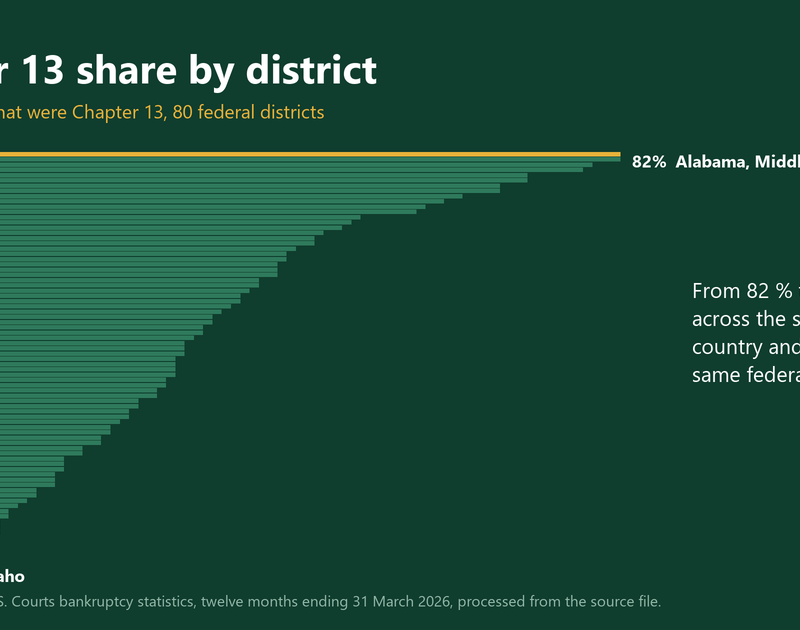
The section above says that people who cannot assemble the cash often end up in a repayment plan even when the liquidation was the better chapter for them. The filing table shows how far that can go in one courthouse. Nationally, 36.9% of consumer cases are plans. In Alabama’s Middle District it is 82.1%: 1,186 consumer liquidations against 5,446 plans in a single year. In Idaho the same figure is 8.1%.
We cannot tell you why, and the table does not say. Two of the candidate explanations point in opposite directions for your wallet. One is local practice: a bar and a bench that run plans as their standard product. The other is exactly the cash-flow trap described above — a chapter whose fee is financed through the plan is available to someone who has no money today, and the chapter whose fee is due before filing is not. Both are consistent with these numbers, and this data cannot separate them.
What it does give you is a question with a right to an answer. If you are in one of the districts in the table below and you are being routed toward a plan, the thing to ask is whether that is because of your income, your equity or your arrears — or because of the fee. If it is the fee, the three routes above exist for precisely that: legal aid, a law school clinic, or preparing the packet yourself with a paid review of the schedules. Which chapter your facts actually point to is a separate question with its own test: the three filters that decide it, and the full district table if you want to see where your own courthouse sits.
| District | Consumer Chapter 7 | Consumer Chapter 13 | Chapter 7 share |
|---|---|---|---|
| Alabama, Middle | 1,186 | 5,446 | 17.9% |
| Georgia, Southern | 725 | 3,289 | 18.1% |
| Louisiana, Western | 1,168 | 4,733 | 19.8% |
| Alabama, Southern | 932 | 3,285 | 22.1% |
| North Carolina, Eastern | 1,358 | 4,077 | 25.0% |
| Louisiana, Eastern | 784 | 2,286 | 25.5% |
| Tennessee, Western | 2,416 | 6,522 | 27.0% |
| Georgia, Middle | 2,111 | 4,674 | 31.1% |
| South Carolina | 1,832 | 3,638 | 33.5% |
| Puerto Rico | 2,100 | 3,807 | 35.6% |
| Mississippi, Northern | 1,757 | 2,905 | 37.7% |
| Alabama, Northern | 4,241 | 6,314 | 40.2% |
How we checked the filing table before quoting it
One check has to pass before a district figure is worth printing. Table F-2 carries a Total row. We never use it as an input: we sum the 93 district rows ourselves and compare. In all three releases used here the two agree exactly, chapter column by chapter column — 608,511 cases in the most recent one. A parser that silently drops a row or reads one twice fails that comparison, and that failure is the only warning you get.
The consumer figures come from the table’s own nonbusiness columns rather than from any estimate of ours. Business cases are excluded from every consumer number above, and Chapter 11 and the residual chapters are excluded from the plan share, because the question there is which of the two consumer chapters a consumer case became.
| Source | Administrative Office of the United States Courts, Table F-2, U.S. Bankruptcy Courts Business and Nonbusiness Cases Commenced by Chapter of the Bankruptcy Code |
|---|---|
| What we asked it | We read the official XLSX releases for the 12-month periods ending June 30, 2026, March 31, 2026 and June 30, 2025, district row by district row, summed the rows and compared the sum with the Total row printed on each release before computing anything |
| Data as of | 12-month periods ending June 30, 2026 and June 30, 2025 |
| Retrieved | September 2, 2026 |
| Assumptions | Consumer counts are the table’s own nonbusiness columns, not an estimate; the plan share is consumer Chapter 13 over consumer Chapter 7 plus consumer Chapter 13, and districts with fewer than one hundred consumer cases are left out of the ranking; the year-earlier release has one fewer district row, so the two releases are compared district code by district code rather than by row position |
| How to repeat it | Download the F-2 workbook for the period ending June 30, 2026 from the courts’ data-tables page, read the nonbusiness Chapter 7 and Chapter 13 columns, sum the district rows and check the sum against the printed Total row before dividing anything |
| Release (12 months to) | District rows | Our sum of the rows | The printed Total row | Chapter 7 | Chapter 13 | Agree? |
|---|---|---|---|---|---|---|
| June 30, 2026 | 93 | 608,511 | 608,511 | 382,161 | 215,490 | yes |
| March 31, 2026 | 93 | 591,850 | 591,850 | 369,702 | 211,700 | yes |
| June 30, 2025 | 92 | 542,529 | 542,529 | 333,321 | 200,290 | yes |
What this does not say.
- The filing table contains no money. It carries no filing fees, no attorney fees and no course fees, so nothing above is evidence about what a lawyer in a given district charges. It is evidence about how much of what kind of work that district does.
- It cannot tell you why a district files the way it does. Local practice and the cash-flow problem described above would both produce these numbers, and separating them would need fee data the courts do not publish here.
- These are cases commenced, not cases finished. Nothing here says how many Chapter 7 cases were discharged or how many plans completed, and a district’s chapter mix is not a measure of how well either chapter works there.
- A quote is individual. Volume describes a market, not your case, and the things that move a fee — equity, self-employment, transfers, a prior filing — are facts about you that no national table contains.
Frequently asked questions
Can I file bankruptcy for free? Effectively yes, for low incomes: the filing fee can be waived on Form B103B, the required courses are often free or reduced on a sliding scale, and legal aid or a law school clinic may represent you at no cost. The waiver is a routine application, not an exotic one.
How much is the Chapter 7 filing fee? It is $338 at the fee schedule in force, subject to change, so confirm the current amount on the court’s own schedule. Waiver and installment applications are both available, on Forms B103B and B103A respectively.
Do I have to pay attorney fees before filing? For Chapter 7, generally yes, because the fee cannot be paid from the estate afterward. Chapter 13 fees are commonly paid through the plan, which is one reason people without cash end up there even when the shorter chapter fitted their facts better.
Does it cost more to file in some districts than others? The court’s filing fee does not vary; it is federal and flat. Attorney fees do vary, and the filing data shows why the local market differs: some districts open more than twenty thousand consumer Chapter 7 cases a year while others open a few hundred, and some route four cases in five into a repayment plan instead.
What happens if I cannot afford the whole fee at once? File Form B103A to pay in installments, or B103B to request a waiver if your income qualifies. Do not delay filing over the fee if a garnishment or foreclosure is imminent, because the applications exist for exactly that situation.
Are the credit counseling courses a scam? The requirement is real and the providers must be approved by the Department of Justice. Courses sold outside that approved list do not satisfy the requirement, which is the actual scam risk here rather than the fee itself.
This article lists typical Chapter 7 costs. Court fees change and attorney fees vary widely by district and case complexity — verify the current fee schedule and get quotes locally. Not legal advice.
Sources
- U.S. Courts — Bankruptcy Court Miscellaneous Fee Schedule
- Official Form B103B — Application to Have the Chapter 7 Filing Fee Waived
- Official Form B103A — Application to Pay the Filing Fee in Installments
- DOJ U.S. Trustee — approved credit counseling providers and fee waiver policy
- Administrative Office of the U.S. Courts — Table F-2, bankruptcy filings by district and chapter, 12-month period ending June 30, 2026 (accessed 2026-09-02)
Information, not advice. How we calculate, source and review this — and what we do not do — is set out on our methods and sourcing page.