Sometimes — and it depends on the age of the tax, not on the amount. Older federal income tax debt can be discharged in Chapter 7. Recent income tax cannot. Payroll and trust fund taxes never can. And a tax lien already recorded against your property survives the discharge even when the underlying tax liability does not.
That last point is the one that surprises people, and it is why “cleared” needs qualifying.
The three rules, as a test you can run
For a federal income tax debt to be dischargeable, all three must be true:
1. The three-year rule. The return was due more than three years before your bankruptcy filing date, including extensions. So a 2022 return due in April 2023 clears this test in April 2026 — later if you extended.
2. The two-year rule. You actually filed the return more than two years before the bankruptcy filing. An unfiled return never becomes dischargeable, and a substitute return prepared by the IRS on your behalf generally does not count as your filing.
3. The 240-day rule. The tax was assessed more than 240 days before filing. Assessment usually follows filing, but it can come much later after an audit or an amended return.
Plus a disqualifier: no fraud or willful evasion. A fraudulent return or deliberate evasion makes the tax non-dischargeable regardless of age.
Run it on your own dates. Get an IRS account transcript for each year in question — it shows the filing date and the assessment date, which are the two facts these rules turn on and the two facts people misremember.
Why timing changes the answer
Because these are all clocks. A tax debt that is not dischargeable today may be dischargeable in four months, and filing a few weeks earlier can cost the discharge of an entire tax year.
Two complications that make this a specialist question rather than a calendar exercise:
- The periods can be suspended. A pending offer in compromise, a prior bankruptcy, or certain collection due process appeals can pause the clocks, pushing the eligible date later than a simple count suggests.
- Multiple years, multiple answers. It is common for older years to be dischargeable and recent ones not, in the same case.
This is one of the clearest cases in consumer bankruptcy for professional advice on when to file rather than just whether. See how filing timing works.
What never gets discharged
- Payroll taxes and trust fund taxes — the withheld employee portion. Never dischargeable, and personal liability can attach to responsible individuals in a business.
- Tax debt from an unfiled return. File the returns first; the two-year clock cannot start otherwise.
- Fraud penalties, and tax where evasion is established.
- Recent income tax failing any of the three rules — though it can be handled in Chapter 13.
The lien problem
Even where the tax is discharged, a Notice of Federal Tax Lien recorded before your filing remains attached to your property.
Practically: your personal liability to pay disappears, and the lien on your house stays until it is satisfied, released, or expires. You cannot sell or refinance cleanly with it in place. This is the single most important caveat on this page, because it means a “successful” discharge can leave a homeowner with the problem largely intact.
Whether the lien can be avoided or reduced depends on facts including equity and exemptions, and it is squarely a question for counsel.
What Chapter 13 does instead
For recent tax debt that cannot be discharged, Chapter 13 is often the better tool. It does not erase priority tax debt — it restructures it:
- Priority tax must be paid in full over the plan, but over three to five years, in the plan payment.
- Interest and penalties generally stop accruing on priority tax once the plan is confirmed, which is a substantial benefit on a large balance.
- Older, non-priority tax may be treated as general unsecured debt and receive whatever percentage other unsecured creditors do — sometimes very little.
- Collection stops immediately on filing, including levies and wage garnishment.
For someone with $40,000 of recent tax debt and no ability to pay it in a lump sum, that structure is frequently the most useful thing available. See why Chapter 13 handles tax debt differently.
Compare it with the IRS’s own programs first
The IRS has remedies that do not require a bankruptcy filing, and for tax-only problems they are usually the first stop:
- Installment agreements, including streamlined versions for balances under set thresholds.
- Offer in Compromise — a genuine settlement program that accepts less than the full amount from taxpayers who qualify. This is the real federal debt forgiveness program, and it applies to taxes.
- Currently Not Collectible status, which pauses collection when paying would prevent meeting basic living expenses.
- Penalty abatement, including first-time abatement, which is granted more often than people expect.
Each of these is requested directly from the IRS, without a court filing. The Offer in Compromise is the only one that reduces the balance itself, and the IRS decides it on ability to pay — income, expenses and equity in assets — rather than on hardship alone. It also cannot be considered while a bankruptcy case is open, which is one reason the order of these two decisions matters. If tax debt is your only significant debt, start there rather than with bankruptcy.
What the court statistics record about tax debt, and what they do not
The three tests above decide whether a particular tax year is dischargeable. The obvious next question is how often it actually happens — what share of filers walk out with federal income tax cleared. We went looking for that figure in the federal courts’ own statistics, and it is not there. This section is about the shape of that hole, because a gap whose edges you can see is worth more than a number someone has estimated for you.
The courts publish bankruptcy volumes in Table F-2, which is the most granular public count of consumer bankruptcy in the United States and the source almost every filing statistic you will read traces back to. We read the official workbook for the twelve months ending in June 2026. It records 608,511 filings: 382,161 Chapter 7, 215,490 Chapter Thirteen, 10,320 Chapter 11 and 540 in the remaining chapters. It then splits every one of those counts again by whether the case’s debt is predominantly business or consumer.
That is the entire vocabulary of the table. Fourteen numeric columns, and not one of them is about a debt. There is no tax column. There is no column for what was discharged, none for what survived, none for whether a lien was recorded against the house. The table answers how many cases, of which chapter, in which court. It cannot answer how much tax was cleared, and no arithmetic performed on it can, which is why you will not find that percentage on this page in any form.
This matters beyond pedantry, because the figure people want does circulate. If you are shown a share of bankruptcies that cleared tax debt, ask which table it came from and which column. The most authoritative filing data the federal judiciary publishes does not contain the field, and a number that cannot be traced to a field is a number someone built.
| Column group in the Table F-2 workbook | Numeric columns | What it counts |
|---|---|---|
| Circuit and district | — | the court, not the debtor |
| Total: all chapters, and Chapters 7, 11, 13 and other | 5 | cases filed, by chapter |
| Predominant nature of debt: business | 5 | the same five counts, business-debt cases only |
| Predominant nature of debt: nonbusiness | 4 | the same counts, consumer-debt cases only, with no other-chapters column |
| Any column identifying a kind of debt | 0 | tax, medical, student, secured: none of them appear |
| Any column recording an outcome | 0 | no discharge, dismissal or debt-cleared field |
Where a real answer would have to come from
Saying the number is not in this source is only half of an honest answer. The other half is telling you what would have to be read to produce one, so you can check us or go further. There are three routes, in order of how tractable they are.
- Your own transcripts. For your case the answer is knowable and it is not statistical. The IRS account transcript for each year shows the date the return was filed and the date the tax was assessed, which are the two facts the three tests above turn on and the two facts people misremember.
- The docket, one case at a time. A consumer discharge order does not itemise debts, so establishing what a discharge did to a tax year means reading that case’s schedules and any determination in the file. That is per-case work and it does not aggregate into a national rate without someone funding the aggregation.
- The court’s other statistical tables. Table F-2 is one of a family the Administrative Office publishes. We read this one. We are not claiming, on the strength of one table, that no court statistic anywhere touches tax claims — only that the table everyone uses for bankruptcy volumes has no such field.
That third point is the one we would want stated if someone else had written this page. It is easy to slide from we did not find it to it does not exist. We inventoried one workbook, we know exactly which columns it has, and the claim is bounded by that.
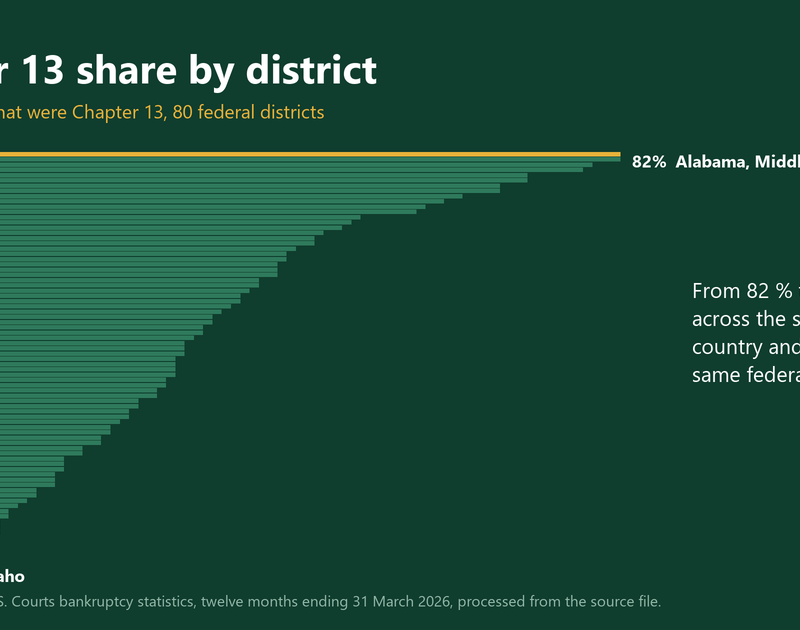
What the court data does support is the structural point the rest of this page makes. Recent tax that fails the three tests is not erased, it is restructured, and the chapter that restructures it is 35.4% of all filings nationally — more than a third of the calendar. Whether that chapter is the routine local answer where you file varies enormously, which we measured in the Chapter Thirteen share by district. And the relief that arrives on day one has nothing to do with discharge at all: the stay stops a levy immediately, including on tax that will never be discharged — see how the stay stops a garnishment and what a discharge does and does not clear.
How we checked, and the five things this cannot settle
The measurement here is a column inventory rather than a calculation, which makes it unusually easy to reproduce: open the workbook, read the two header rows, count the columns. Anyone can contradict us in about two minutes, which is the property we want in a claim about an absence.
The only arithmetic is the chapter shares, and those come from the national totals row of the same sheet. The court publishes the counts; the percentage of filings that are the repayment chapter is ours.
| Source | Administrative Office of the United States Courts, Table F-2, Bankruptcy Filings by District, read from the official XLSX workbook rather than the PDF |
|---|---|
| What we asked it | We opened the workbook for the twelve months ended June 30, 2026 and read its header rows to list every column it publishes, then took the chapter counts from the national totals row. The question we put to it was whether any column identifies a kind of debt beyond the business or nonbusiness classification of the case. None does. |
| Data as of | Twelve months ended June 30, 2026 |
| Retrieved | September 2, 2026 |
| Assumptions | The inventory is of the F-2 workbook for this period, and the court can add or rename columns in a later release; the business or nonbusiness flag is the table’s only debt-related field, and it classifies the whole case rather than any individual debt; no attempt was made to inventory every statistical table the Administrative Office publishes, so the absence reported here is an absence in this table and is stated as such |
| How to repeat it | Download the F-2 workbook for the period from the court’s data tables page and read the header rows: one district label, five counts by chapter, the same five repeated for business debt, and four for nonbusiness debt, which has no other-chapters column. There is nothing beyond those. |
What this does not say.
- This is a declared gap, not a finding about the law. Nothing here says tax debt is rarely discharged, or often discharged. It says the federal courts’ filing table does not count it, which is a different sentence and the only one this source supports.
- The absence is an absence in Table F-2 for this period. We did not inventory every court publication, and a later release could add a column.
- The chapter counts are filings, not discharges. A Chapter 7 filing is not a Chapter 7 discharge, and this table records nothing about which cases were dismissed or converted.
- None of this touches state tax, which the section above flags as a separate analysis. The table does not distinguish federal from state claims for the simple reason that it does not record claims at all.
- The three tests are dates in your own file. No aggregate statistic could answer them for you even if one existed, because the answer turns on your return’s due date, the date you filed it and the date the tax was assessed.
Frequently asked questions
Can you file bankruptcy on back taxes? Yes, but discharge depends on the three tests: the return was due more than three years ago, was actually filed more than two years ago, and the tax was assessed more than 240 days ago, with no fraud or willful evasion. Unfiled years cannot be discharged at all, because the two-year clock never starts.
Does Chapter 7 wipe out tax debt? Only tax that passes all three tests. Recent income tax, payroll and trust fund taxes and tax from unfiled returns survive, and a recorded lien survives regardless of whether the underlying liability does. The federal courts publish no statistic on how often any of this happens, so treat any percentage you are shown with suspicion.
Do tax liens survive bankruptcy? Generally yes. The discharge removes your personal obligation to pay; a Notice of Federal Tax Lien recorded before you filed stays attached to the property. Removing it is a separate process, and it is the reason a successful discharge can leave a homeowner with the problem largely intact.
Should I file bankruptcy or apply for an Offer in Compromise? If tax is your only significant debt, start with the IRS programs — an installment agreement or an Offer in Compromise. Bankruptcy makes more sense when the tax sits alongside substantial other debt, or when older tax years already qualify. An Offer in Compromise cannot be considered while a bankruptcy case is open, so the order of the two decisions matters.
This article explains how federal tax debt is treated in consumer bankruptcy. It is not legal advice and not tax advice. The rules turn on specific dates, the periods can be suspended by prior filings or pending applications, and liens are handled separately from the debt. Get your IRS transcripts and advice from a bankruptcy attorney and a tax professional before acting.
Sources
- 11 U.S.C. §507 — Priorities: subsection (a)(8) on governmental claims for taxes
- IRS Publication 908, Bankruptcy Tax Guide — federal income tax aspects of bankruptcy
- IRS — Offer in compromise: settling tax debt for less than the full amount owed
- Administrative Office of the U.S. Courts — Table F-2, Bankruptcy Filings by District, twelve months ended June 30, 2026 (accessed 2026-09-02)
- Table F-2 workbook (XLSX) for the twelve months ended June 30, 2026 — the file whose columns we inventoried (accessed 2026-09-02)
Information, not advice. How we calculate, source and review this — and what we do not do — is set out on our methods and sourcing page.