The common minimums are two years after discharge for FHA and VA loans, three for USDA, and four for a conventional loan — with shorter paths where documented extenuating circumstances apply. All of these are measured from your discharge date, not your filing date, which for most Chapter 7 cases puts the clock about three to four months later than people assume.
These are program minimums. Individual lenders add their own requirements on top, and meeting the minimum is not the same as being approved.
The waiting periods
| Loan type | Minimum after Chapter 7 discharge | Notes |
|---|---|---|
| FHA | 2 years | Shorter with documented extenuating circumstances and re-established credit |
| VA | 2 years | Similar treatment; VA underwriting weighs the overall picture |
| USDA | 3 years | Rural/income-eligible areas |
| Conventional (Fannie/Freddie) | 4 years | 2 years with documented extenuating circumstances |
Verify these against the current handbook before relying on them. Program guidelines are updated by circular and mortgage lenders track them closely; a figure that was right last year may not be right now.
After Chapter 13 the treatment is different and often more favorable than people expect: FHA can allow a purchase after a period of on-time plan payments with court permission — potentially while the plan is still running. Conventional waiting periods run from the discharge or the dismissal date, with dismissal treated less favorably. See how the wait differs after Chapter 13.
What “extenuating circumstances” actually means
This is the part worth understanding, because it can cut a four-year wait to two.
It means a non-recurring event outside your control that caused a sudden and significant reduction in income or a catastrophic increase in obligations — a serious illness, a death, a layoff from a company closure. It does not mean overspending, divorce in most interpretations, or a business that failed for ordinary reasons.
It requires documentation: a written explanation plus third-party evidence of the event and of the recovery. Lenders take this seriously and underwriters ask for proof, so it is not a box to check but a case to make.
What the lender looks at besides the clock
Meeting the waiting period gets you considered. These get you approved:
- Re-established credit with a clean payment history since discharge. Underwriters want to see accounts opened after the bankruptcy, paid on time, over a meaningful period. Zero new credit is a problem, not a virtue.
- No new derogatory events. A single 30-day late after discharge does more damage to an application than the bankruptcy itself at this point.
- Debt-to-income ratio. Discharged debt is gone, which usually helps this substantially — one of the few ways a bankruptcy improves a mortgage application.
- Stable, documented income, generally two years of history.
- A credit score meeting the program and lender minimums. These differ by program and by lender, and the lender’s requirement is often higher than the program’s.
- Down payment and reserves. More of both offsets a lot.
What to do during the wait
The two years are not dead time. They are the file you will be underwritten on.
In the first six months after discharge:
- Get the discharge order and keep it — you will be asked for it. See what the discharge paperwork looks like.
- Pull all three credit reports and dispute anything still showing a balance on a discharged debt. This is a common and correctable error, and it will hurt your application.
- Open a secured credit card, use a small fraction of the limit, and pay it in full monthly.
Months 6–24:
- Add a second small tradeline; a credit-builder loan adds installment history.
- Keep utilization low — it is the fastest lever you have. Underwriters and scoring models both read the balance each card reports against its limit, and that figure is rebuilt from the latest statement every month, so it moves faster than anything else in the file.
- Save. Reserves and down payment do heavy lifting in post-bankruptcy underwriting.
- Do not open anything in the three to six months before applying.
Full sequence: how to rebuild credit during the wait.
Two things people get wrong
The bankruptcy staying on your report for ten years is not a ten-year wait to buy. The report entry and the mortgage waiting period are separate. Lenders underwrite to the program’s waiting period, not to when the entry disappears. See how long the filing stays on your report.
Not all lenders are equal on this. Overlays vary considerably, and a rejection from one lender at 25 months does not mean the answer is no everywhere. It is worth talking to a broker who works with post-bankruptcy files rather than assuming the market speaks with one voice.
Which discharge most buyers are counting from
Every waiting period above runs from a discharge, so the question underneath them is which discharge. Table F-2 from the Administrative Office of the U.S. Courts answers it for the country as a whole: of the 608,511 bankruptcy cases filed in the twelve months ending in June 2026, 382,161 were Chapter 7 — 62.8%. The two-year clock measured from a Chapter 7 discharge is the one most people reading this page are on, which is also why it is the one lenders have the most settled practice around.
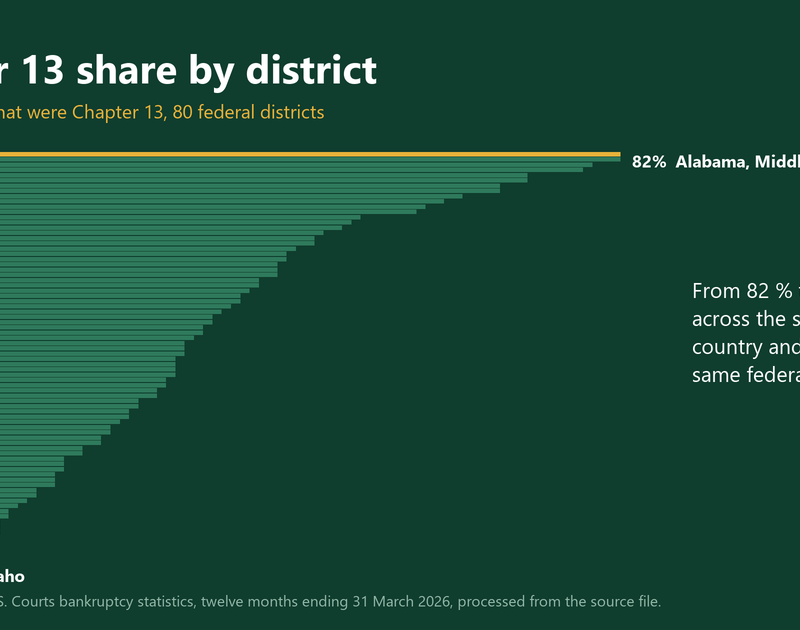
The share is not the same everywhere, and the gap is wide enough to change what a local loan officer sees all day. In the Central District of California, 84.3% of all filings were Chapter 7. In the Northern District of Ohio, 82.0%. In the Middle District of Alabama, 18.2% — fewer than one filing in five — because that district runs overwhelmingly on the repayment chapter, where a purchase is a question of plan payments and court permission rather than of a discharge date. We measured that split on its own in the Chapter Thirteen share by district.
Two things follow from this, and only two. First, if your case was a Chapter 7, the date that starts the clock is on the discharge order rather than on the petition, and for a typical case that is a few months later than people plan for. Second, if you filed in a district where the repayment chapter dominates, the first broker you speak to may be more practised in that path than in yours — or the reverse, in a district like the Central District of California. A single answer from a single lender is not the market’s answer, and that is worth knowing before a rejection at twenty-five months talks you out of applying anywhere else.
What none of this does is move a waiting period. The program minimums in the table at the top of this page come from the lender handbooks and change by circular; the court’s data has nothing to say about them. It only tells you which chapter the discharge in your file is likely to have come from, and which lien and debt survived it — see what a discharge does and does not clear.
| Source | Administrative Office of the United States Courts, Table F-2, Bankruptcy Filings by District, read from the official XLSX workbook rather than the PDF |
|---|---|
| What we asked it | For the twelve months ended June 30, 2026 we took the Chapter 7 column and the all-chapters total, nationally and for each of the 93 districts, and divided one by the other to get the Chapter 7 share of filings. |
| Data as of | Twelve months ended June 30, 2026 |
| Retrieved | September 2, 2026 |
| Assumptions | The share is computed on filings of all kinds, business and consumer together, because that is how the F-2 reports district rows; a filing is treated as the origin of the discharge a lender will later ask for, which is true only for the cases that actually reach discharge; the districts shown are a spread chosen to bracket the national figure, not the top eight of anything |
| How to repeat it | Download the F-2 workbook for the period from the court’s data tables page, then divide the Chapter 7 column by the total column, for the national row and for any district row. |
| District | All filings | Chapter 7 filings | Chapter 7 share |
|---|---|---|---|
| Central District of California | 32,188 | 27,137 | 84.3% |
| Northern District of Ohio | 14,960 | 12,263 | 82.0% |
| Middle District of Florida | 29,567 | 22,851 | 77.3% |
| Eastern District of Michigan | 19,464 | 13,308 | 68.4% |
| District of Maryland | 13,503 | 8,607 | 63.7% |
| Northern District of Illinois | 23,071 | 13,256 | 57.5% |
| Northern District of Georgia | 22,619 | 12,604 | 55.7% |
| Middle District of Alabama | 6,693 | 1,219 | 18.2% |
| All districts | 608,511 | 382,161 | 62.8% |
What this does not say.
- The court counts filings, not discharges. Cases get dismissed and converted, so the share of buyers who will eventually be counting from a Chapter 7 discharge is close to this figure but not identical to it, and Table F-2 does not publish the outcome.
- Nothing in this data sets or verifies a waiting period. The FHA, VA, USDA and conventional minimums come from the lender handbooks cited above, they are updated by circular, and a court statistic cannot confirm them.
- District rows include business filings. They are a small share of the total nationally, but they are one reason a district’s Chapter 7 percentage is not exactly the percentage among consumers.
- A district share describes what is common where a case was filed. It says nothing about what any individual lender will do with your file, and lender overlays are outside every dataset on this page.
Frequently asked questions
How long after Chapter 7 can I buy a house? Commonly two years after discharge for FHA and VA, three for USDA, four for conventional — or two years conventional with documented extenuating circumstances. Confirm current figures against the handbooks, because program guidelines change by circular and lenders add requirements of their own on top of them.
Does the waiting period start at filing or discharge? Discharge. For a typical Chapter 7 that is roughly three to four months after filing, so the clock starts later than most people plan for. Chapter 7 was 62.8% of the 608,511 cases filed in the twelve months to June 2026, which makes this the version of the question most buyers are actually asking.
What credit score do I need for a mortgage after bankruptcy? It depends on the program and on the individual lender, whose requirement is often stricter than the program minimum. What matters as much is a clean post-discharge payment history and re-established accounts: zero new credit is a problem in underwriting rather than a sign of caution.
This article summarizes mortgage waiting periods after bankruptcy. These are program minimums that change and that individual lenders supplement with their own requirements — verify against the current handbook and speak to a lender about your file. Not legal or individual financial advice.
Sources
- HUD Handbook 4000.1, FHA Single Family Housing Policy Handbook (PDF) — bankruptcy waiting periods
- Fannie Mae Selling Guide B3-5.3-07 — four years after a Chapter 7 discharge, two with documented extenuating circumstances
- VA Lender’s Handbook (VA Pamphlet 26-7), Chapter 4, Credit Underwriting — treatment of a discharged bankruptcy. Not linked: VA’s public copies of this chapter now redirect to a knowledge base that will not serve the document to a reader without JavaScript.
- USDA Rural Development Handbook HB-1-3555
- Administrative Office of the U.S. Courts — Table F-2, Bankruptcy Filings by District, twelve months ended June 30, 2026 (accessed 2026-09-02)
- Table F-2 workbook (XLSX) for the twelve months ended June 30, 2026 — the district and chapter columns used here (accessed 2026-09-02)
Information, not advice. How we calculate, source and review this — and what we do not do — is set out on our methods and sourcing page.