Writes and edits PayoffPath. Not a lawyer, not a credit counsellor and not a financial adviser: the work here is reading the primary sources - the U.S. Courts statistics tables and the official bankruptcy forms, the CFPB, the FTC, the eCFR and the Federal Reserve - checking the date on every figure, and setting it out in plain English. There is no professional review behind these articles, and the site says so rather than implying a credential it does not have: where a decision turns on your own circumstances, the page points you to the court, the agency or the attorney that can answer it.
The stack above is measured against the balance. Paying the same balance at 22.15 percent adds 7,553 dollars over three years, and a fee inside the documented band eats every…
Three tests answer it, and none of them is a national average. Plus what the Federal Reserve's 1.35 trillion revolving credit total can and cannot tell you.
Modification comes first; the hardship discharge is what becomes reachable when it is not possible. Plus the federal counts: 214,153 consumer plans started in a year, and why no completion…
Reading Regulation F on the thirty-day validation period. Plus how often the notice itself is the complaint: 54,617 of 324,326 federal collection complaints.
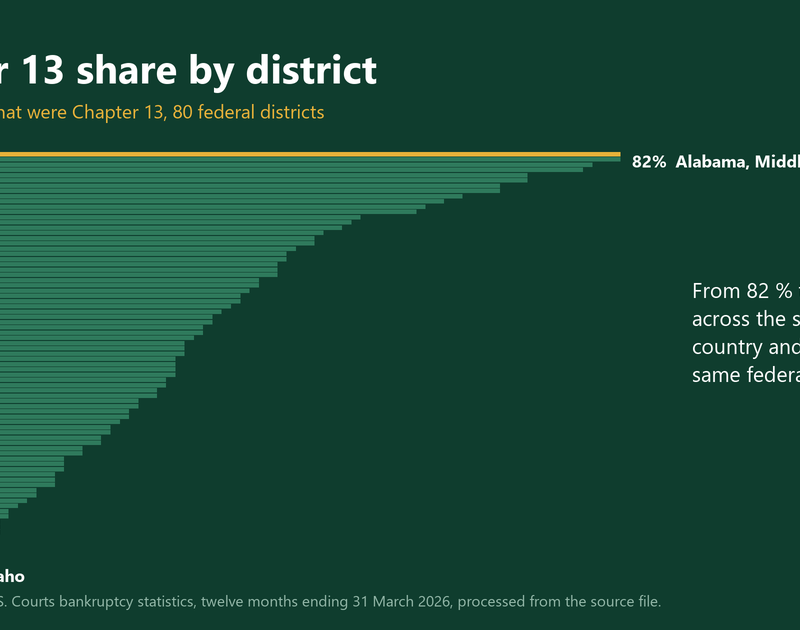
Chapter 13's share of consumer bankruptcies by federal district, rebuilt from the June 2026 court release: 36.9% nationally, 82.1% in one district and 8.1% in another, plus filings per head…
Five different things sold under one phrase. Plus the federal record: money comes back in 14.35% of card complaints and 0.13% of collection complaints.
Chapter 7 is faster and cheaper; Chapter 13 does what 7 cannot. Plus the federal filing data: 36.9% of consumer cases are Chapter 13 nationally, 82.1% in one district and…
At 22.15 percent the term depends on the payment as a share of the balance, not on the balance. Two percent a month takes 141 months and costs 2.8 times…
We use cookies to run this site, to measure which articles are read, and — where you allow it — to show advertising. You can accept, reject, or read exactly what each one does.